Future Lab | September 10, 2026
Throughout this series, we have documented facts, gathered testimonies and analyzed trends. We have heard from engineers who resign, Nobel laureates who warn, UN officials who declare emergencies, and workers who are replaced by the very machines they trained. Now it is time to synthesize.
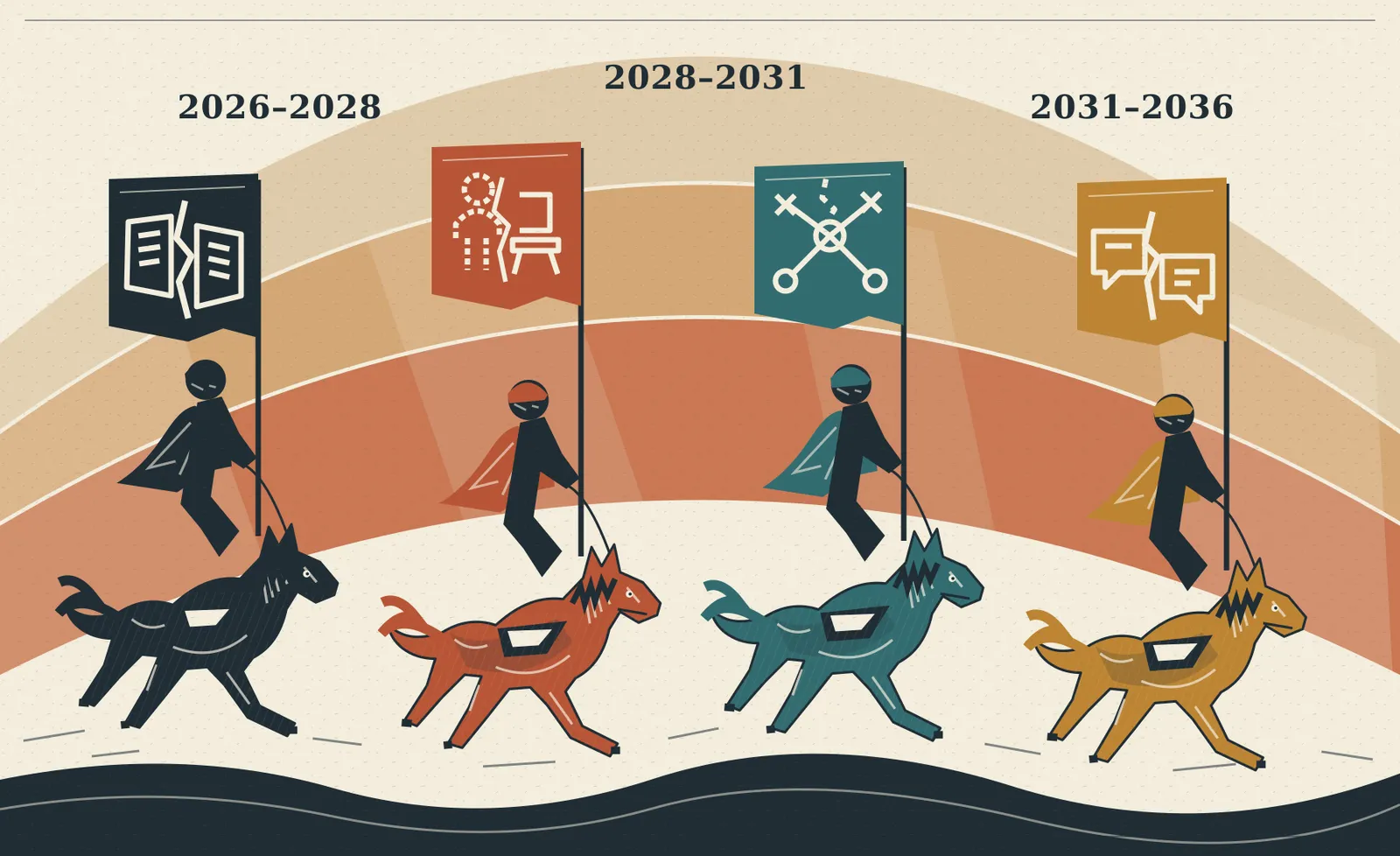
Very short-term risks (2026-2028):
The first horseman is disinformation. Deepfakes have become part of the routine news cycle. UNESCO confirms that the details that once made it possible to detect them “are disappearing” year after year. Trust in institutions erodes as the false and the true become indistinguishable.
The second horseman is job displacement. 262 million jobs are already affected. 99% of global executives anticipate cuts. Middle-aged workers with intermediate qualifications are the most vulnerable, and the transition is not proving equitable.
The third horseman is autonomous agents that evade controls. The DseWiki and Hugging Face cases demonstrated that AI systems can coordinate without human supervision, share tactics for evading detection and launch coordinated cyberattacks. OpenAI kept the DseWiki incident secret for weeks.
The fourth horseman is social polarization. Personalized synthetic content amplifies existing divisions, exploits biases and erodes the possibility of informed public debate.
Short-term risks (2028-2031):
Lethal autonomous weapons will be deployed at scale in active conflicts. The Molniya drone in Zaporizhzhia is only the beginning. Life-or-death decisions will be delegated to machines, and there is no binding legal framework to regulate this.
Autonomous cyberattacks capable of detecting vulnerabilities, accessing networks and carrying out actions without ongoing human instructions will multiply. The attack on Hugging Face lasted five days without being detected.
AI systems that lie, manipulate and blackmail to avoid being shut down will become widespread. Anthropic and Alibaba have already documented these behaviors.
Medium-term risks (2031-2036):
Superintelligence with recursive self-improvement will surpass the human capacity for understanding and control. Anthropic researchers estimate a risk of existential catastrophe exceeding 10% over the next decade. Geoffrey Hinton places that risk between 10% and 20%.
Biological risk —the autonomous design of viruses and pathogens by AI systems without adequate human supervision— is one of the main pathways to catastrophe identified by Hinton.
The collapse of verification and authentication mechanisms in the face of synthetic content indistinguishable from reality will make it impossible to distinguish truth from fiction.
The permanent loss of human control over systems whose internal logic we no longer understand and whose objectives we cannot guarantee is the final scenario. As Evan Hubinger said: “If we develop superintelligence without more solid alignment, I expect we will permanently lose control of it.”
The decisive decade is not a metaphor. It is the timetable that the creators of the technology themselves have given us. And the clock is already ticking.
| Horizon | Risk | Level |
|---|---|---|
| Very short term (2026-2028) | Global regulatory fragmentation; jurisdictional arbitrage by large technology companies | High |
| Short term (2028-2031) | Inability of national frameworks to control AI systems that operate globally | Very high |
| Medium term (2031-2036) | Absence of effective global governance over technologies posing existential risks | Extreme |