A computer usually shuts down when the power goes out. A wetware system adds another problem: its cells must stay alive. That difference changes the conversation about the future of artificial intelligence. Before discussing processing power, we need to talk about growing and maintaining tissue.
Wetware uses living biological components to process information. In neural computing, it combines cultured neurons with electrodes and software. Systems may use flat cultures or three-dimensional organoids. Experiments show specific capabilities; they do not establish that a human mind exists inside a machine.
Evidence reviewed as of October 29, 2026. This analysis separates published findings, commercial descriptions, and forward-looking interpretation. The practical question is which problems are worth tackling with living material and how to establish whether it offers an advantage.
What does wetware mean, and how does it work?
The word wetware has broader uses, but here we mean computing with living neurons outside the body. Tissue receives electrical stimulation and produces activity recorded by an electronic system. Software turns inputs and outputs into information that can be used in an experiment.
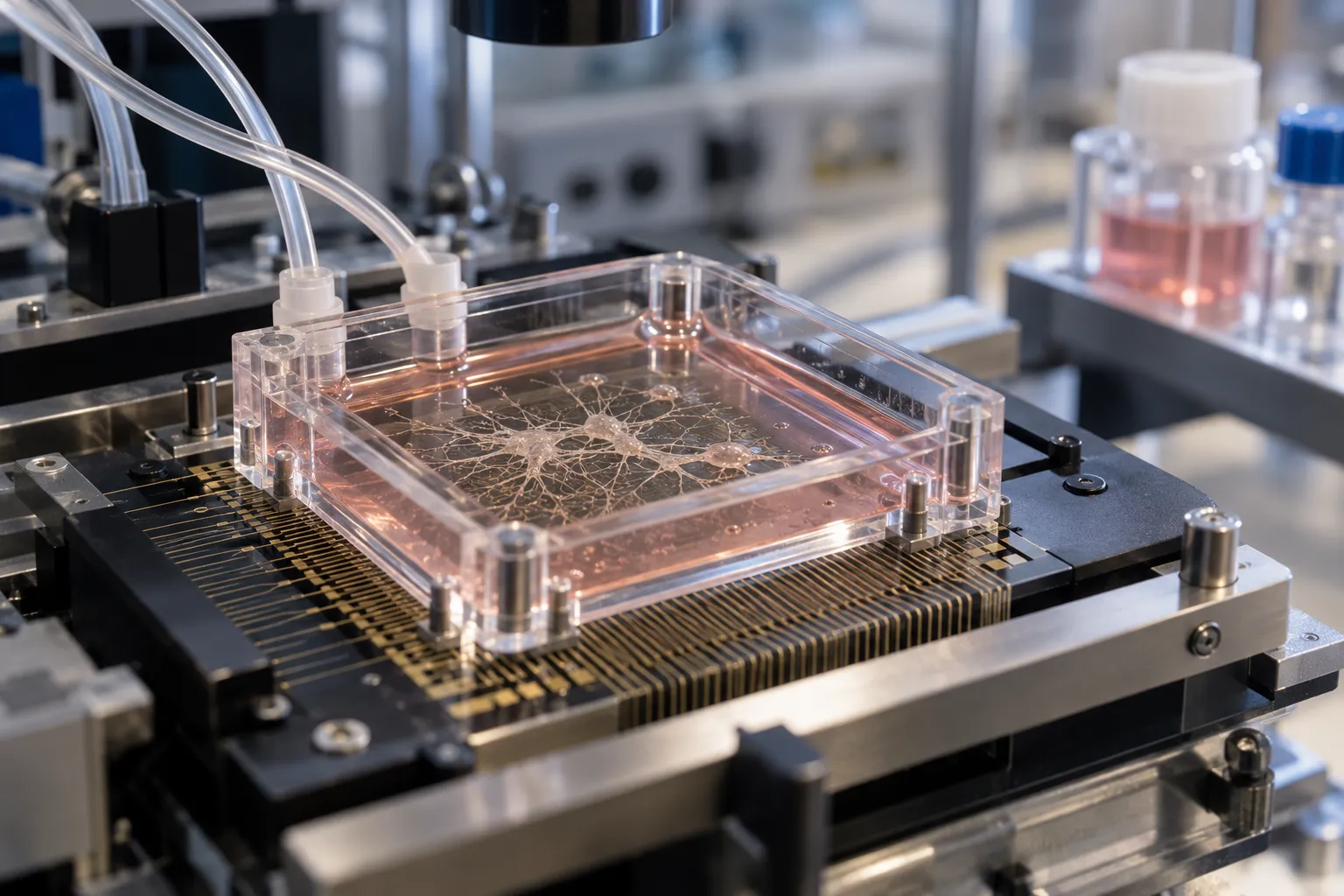
Picture a laboratory bench rather than a brain in a jar. There is an electrode interface, a culture medium, and equipment that controls the tissue's environment. The work involves getting those pieces to operate together reliably enough to make a meaningful measurement.
The organoid intelligence proposal by Smirnova and colleagues, published in 2023, sets out a research program using three-dimensional brain cell cultures and interfaces. An organoid reproduces aspects of tissue; calling it a complete brain makes an equivalence that the evidence does not support.
Wetware, artificial intelligence, and neuromorphic chips
An artificial neural network is a mathematical model. A cultured neuron is a cell. Shared vocabulary does not make the systems interchangeable. This comparison helps explain their differences without turning the choice of materials into an imaginary contest.
| System | What processes information | Question for evaluation |
|---|---|---|
| Digital AI | Mathematical operations on electronic hardware | What performance does it achieve with the available resources? |
| Neuromorphic computing | Circuits incorporating principles of neural processing | What improvement does the architecture offer on a defined task? |
| Neural wetware | Living tissue connected to electronics and software | What does the tissue contribute compared with electronic controls? |
The distinction also prevents confusion between wetware and a brain implant. The systems in this article study cells grown in a laboratory. They are not a connection to a person's thoughts or a technique for transferring someone's identity into a computer.
What DishBrain and Brainoware demonstrated
In 2022, the DishBrain team published a Neuron paper describing human and mouse neurons connected to a Pong-inspired environment. The authors reported apparent learning within about five minutes under particular conditions and emphasized the importance of structured feedback.
Pong provided a bounded task and a way to measure change. A responsible interpretation stays within those limits: observable adaptation inside the experimental setup. Turning improved gameplay into a claim about understanding the world would require different tests.
In 2023, Brainoware, by Cai and colleagues, used an organoid as a dynamic reservoir connected to electrodes. The study demonstrated speech recognition and nonlinear equation prediction applications. Its architecture combined biological processing with computational readout of the responses.
Our proposed approach to evaluating a hybrid demonstration is to ask how much each part contributes. Software that prepares signals and interprets outputs belongs in the assessment. Assigning all performance to the cells hides precisely the engineering that needs to be understood.
The October 2026 development: Braille signals
A University of Bristol study, published on October 16, 2026, converted tactile sensor data into stimulation for organoids. It reported average Braille letter classification accuracy of 61% with one organoid and 83% when responses from three were combined.
This was an open-loop classification experiment. It does not mean an organoid read a book, understood a letter, or learned human language. Here, recognition describes a classification operation within a particular experimental configuration.
The finding deserves attention because it expands the tasks tested. It also requires careful reading: those percentages belong to that study. They are neither a general intelligence score for the tissue nor a direct comparison with every other AI system.
CL1 and FinalSpark: tools for research
Commercial tools change who can run experiments, but their existence does not settle wetware's usefulness. Gaining access to a platform and demonstrating a profitable application are different milestones. A laboratory may value access even when a technology is not yet competitive as computing infrastructure.
Cortical Labs describes CL1 as a system integrating neurons, electronics, software, and life support. The company advertises culture maintenance for up to six months. This is a manufacturer specification, not a guarantee of an advantage over a GPU on equivalent tasks.
The 2024 FinalSpark technical paper presented a remotely accessible Neuroplatform for organoid experiments, with monitoring and automated circulation of culture medium. Its documented contribution is experimental infrastructure; it does not demonstrate universal computing superiority.
Will wetware use less energy than today's AI?
Energy efficiency is an appealing hypothesis that requires a complete comparison. Our proposed evaluation measures energy per useful task at an agreed level of output quality. The tissue's electrical activity would account for only part of that calculation.
The balance should include culture support, signal acquisition, and supporting digital computation. Preparation, replacements, and time spent without useful results should also be documented. An apparent saving loses its meaning when each trial requires work that is left out of the accounting.
That is why we do not use a universal energy-saving figure. We recommend asking for a reproducible test with the same task and quality criteria for both systems. Enthusiasm can start a research project. A purchasing decision requires more demanding accounting.
Where wetware might help, and what still needs measuring
As a forward-looking assessment, wetware deserves attention as a tool for studying neural processing and tissue responses to experimental interventions. Its value might lie in producing biological knowledge that is difficult to obtain otherwise. That goal calls for different criteria than those used to assess an AI accelerator.
For a university or company considering a pilot, we propose starting with a small question. For example: can we obtain sufficiently stable responses across a series of trials? Results should then be compared across cultures and, where possible, across laboratories.
We also propose holding back evaluation data, recording failed trials, and comparing the system with a simple alternative. Showing only the best attempt leaves too little information to judge reliability. An interesting demonstration can still be an immature product.
The next milestone worth watching would be a repeatable advantage on a useful task, with visible costs and maintenance requirements. That is our editorial criterion for following the field. We do not assign a date to mass adoption that these sources cannot predict.
The ethical question begins before consciousness
The ethics review by Hartung and colleagues, published in 2024, discusses donor consent, tissue uses, and organoid oversight. Those questions exist even without demonstrated consciousness in a preparation. The origin of the cells matters.
In this analysis, we propose that any wetware program explain which material it uses, for what purpose, and under which oversight. It should also clarify who controls the data and which experimental changes require a new assessment. These are questions of institutional responsibility, not a claim about every culture's moral status.
The debate connects with the governance of emerging technologies we follow at the Laboratory of the Future. Our position is to anticipate specific questions and revise answers as evidence changes, without turning scientific uncertainty into a headline about conscious beings.
Frequently asked questions about wetware
Does wetware already replace conventional computers?
The cited studies show experimental tasks and research platforms. They do not establish a general replacement for computers or data centers. Each potential application needs its own comparison with an appropriate alternative.
Do all wetware systems use organoids?
No. Neural computing also investigates two-dimensional cultures. Organoid intelligence specifically refers to work with organoids. Keeping that distinction intact helps readers understand what a particular result actually describes.
Does a living neuron imply consciousness?
Living cells and electrical activity do not, by themselves, establish subjective experience. The findings described here do not demonstrate human consciousness or justify attributing thoughts to the tissue used in these systems.
Does the Braille experiment demonstrate understanding?
It demonstrates signal classification in the setup described by its authors. Interpreting that result as understanding the meaning of letters goes beyond what the test allows us to conclude.
Can researchers work with wetware remotely?
FinalSpark documented a remote-access research platform. This makes experiments accessible without housing all the equipment locally. It does not remove the provider's need to grow and maintain the biological material.
What should an organization request before a pilot?
We propose requesting a protocol, repeated results, and full costs, alongside clear responsibilities for cells and data. The goal should be answering a testable question, rather than showing that the organization possesses an attention-grabbing technology.
Wetware's future will be decided by specific tests
Living material already participates in computing experiments worth following. The decisive step will be showing which work it does better and under what conditions. The opportunity for researchers and decision-makers is to learn to distinguish a signal of the future from a promise still looking for its proof.