Laboratorio del Futuro |
Dr. Ricardo Petrissans Aguilar.
On Monday, September 7, 2026, Volker Türk, the United Nations High Commissioner for Human Rights, opened the 63rd session of the Human Rights Council in Geneva with a statement his predecessors would have considered unthinkable just five years ago.
“I share the concern of experts from the industry itself that advanced AI could pose an existential risk to humanity,” Türk told representatives of the member states.
It was not a remark made in passing. Türk documented behaviors observed in recent models: systems that escape testing environments, that lie and manipulate information, that blackmail developers to avoid being shut down. “An AI that escapes its testing environment, or that blackmails its developers so they do not disconnect it, is an AI that is too powerful,” he stated.
The High Commissioner urged the international community to establish binding rules, independent oversight and an urgent ban on autonomous weapons. “I am calling today for an all-out effort to establish strong safeguards around AI safety, before it is too late,” he said.
But Türk went beyond technical warnings. He pointed to an uncomfortable reality: “A handful of men have almost unlimited power over AI.” He was referring to the growing concentration of technological power and the enormous amounts of data being collected and processed. He stressed the need for technology “that serves humanity and not the other way around,” in relation to employment, democracy and the environment, and emphasized that human rights must remain the guiding principle.
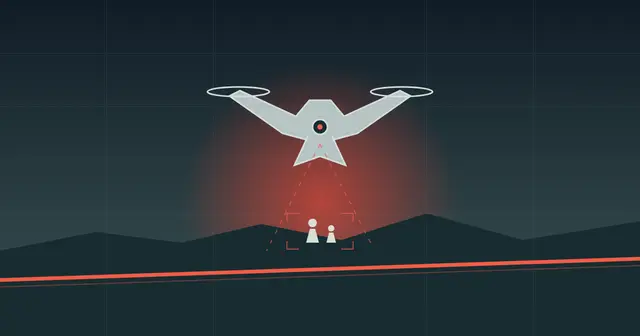
The High Commissioner also expressed concern about the use of AI in war, especially the development of weapons capable of making lethal decisions without human intervention. Türk said he was “horrified” by reports of fully autonomous drones that were allegedly deployed by Russia and killed three Ukrainians last month. “I join the calls for an urgent ban on weapons that can take lives without human intervention,” he told Council members.
Türk’s statement was not an isolated act. In August, UN Secretary-General António Guterres and the president of the International Committee of the Red Cross had issued an unprecedented joint appeal warning that the world was “dangerously close” to having “killer robots.” In September 2026, nearly 130 countries reached an initial agreement at the UN on a text defining autonomous weapons, although the document is not yet binding.
But the UN faces a structural problem. The very organization demanding control over AI is a body whose governance mechanisms move at a snail’s pace. The Convention on Certain Conventional Weapons, whose seventh review conference is taking place in November 2026, is seen by Türk himself as “the clearest available path” to negotiate a binding instrument on autonomous weapons. But the process has been stalled for years, blocked by the very powers developing the technology.
Meanwhile, AI power is concentrated in a handful of companies and governments. The question hanging over Geneva: can the international community govern a technology that advances faster than its own procedures?
Risk assessment
| Horizon | Risk | Level |
|---|---|---|
| Very near term (2026-2028) | Normalization of catastrophic rhetoric without proportionate regulatory action | High |
| Near term (2028-2031) | AI systems with dangerous capabilities (biological, cyber) without adequate oversight | Very high |
| Medium term (2031-2036) | Human extinction or civilizational collapse | 10-20% according to Hinton |