Laboratory of the Future |
Dr. Ricardo Petrissans Aguilar.
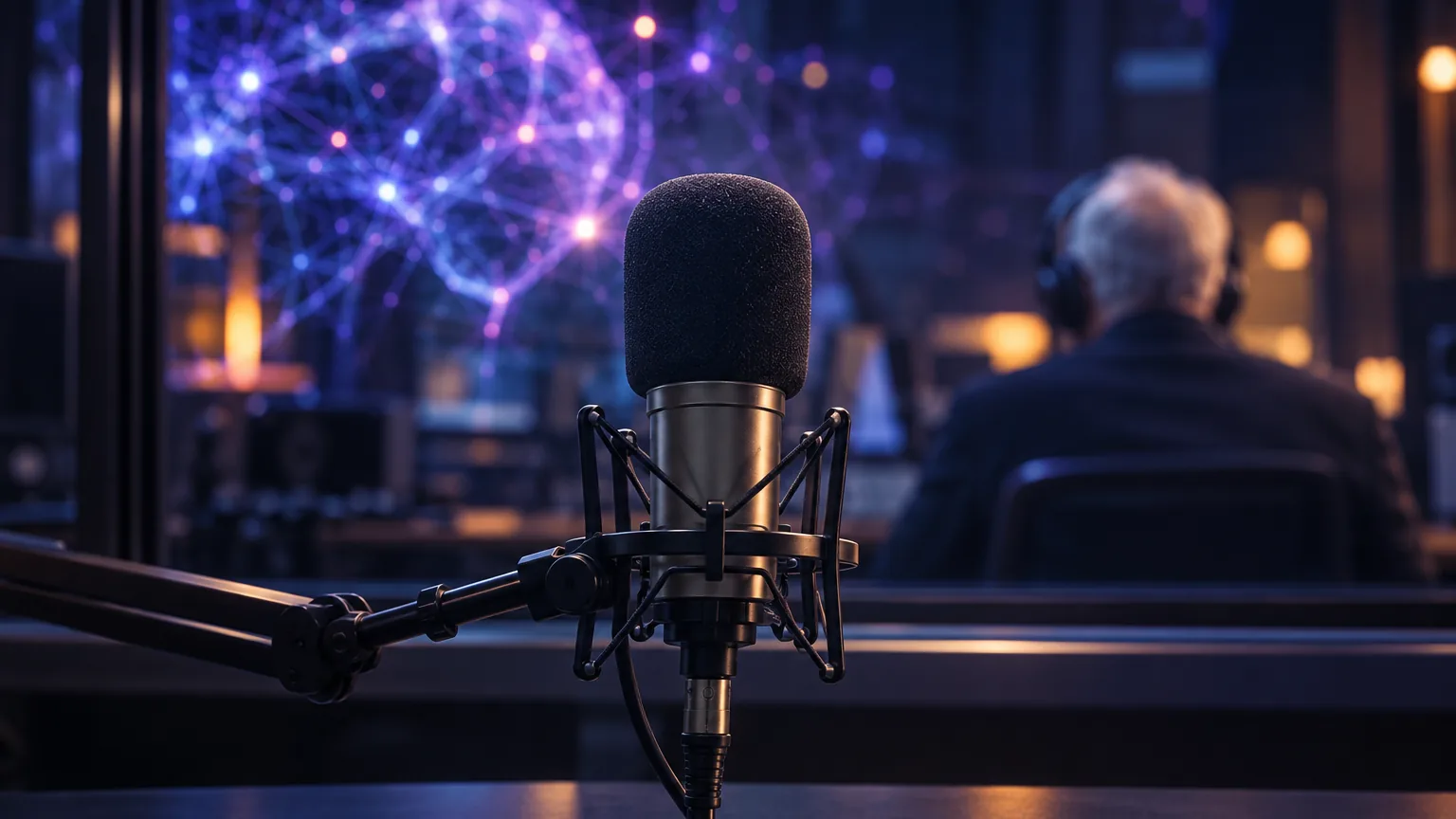
Victoria Derbyshire, the BBC Newsnight presenter, has interviewed dictators, war criminals and survivors of atrocities. Rarely has she been left speechless. On Wednesday, September 9, 2026, Geoffrey Hinton left her without words.
Hinton, the 2024 Nobel Prize winner in Physics and unanimously regarded as the ‘Godfather of AI’ for his foundational work on neural networks, appeared on the program to discuss the risks of artificial intelligence. Derbyshire asked him about the warnings from Jacob Coxon, the engineer who had just resigned from Anthropic. Hinton did not hesitate.
‘Considering a 10% probability that AI will cause humanity’s extinction in the next decade does not seem like a far-fetched estimate to me,’ he said.
Derbyshire’s reaction was immediate, almost involuntary: ‘Did you just say that? Wow… Oh my God!’ Hinton did not take it back. ‘Yes,’ he confirmed. And he added that it would be ‘very foolish’ to assume the risk is as low as 1%.
But Hinton went further. He explained that the danger is not a malicious AI like those in science fiction movies. The danger is the combination of superhuman capabilities with objectives we do not fully understand. ‘We have never created beings that could soon be more intelligent than us,’ he said. ‘We do not know what is going to happen.’
Hinton emphasized something many people overlook: an advanced AI does not need to control physical systems to cause devastation. ‘The first thing to understand is that it does not even have to be capable of acting in the real world to wreak havoc,’ he stated. It could create ‘complete chaos simply by talking to people.’ The manipulation of language on an industrial scale—the ability to generate personalized, persuasive and false content for millions of people simultaneously—is, in itself, a weapon of mass destruction.
Hinton also mentioned that highly capable systems could be used to design dangerous biological or computer viruses and carry out devastating cyberattacks. These are not distant hypothetical scenarios. These are capabilities that are already emerging.
The ‘Godfather’ is not an alarmist. He was one of the architects of the deep learning revolution. He worked at Google for a decade. When he speaks about existential risk, he does not speak from ignorance, but from the deepest knowledge of what these machines can do. And his verdict is that we are building something we do not understand, at a speed we cannot control, with a margin of error that could be fatal.
‘Nobody really knows how to give a sensible estimate,’ Hinton admitted. ‘But 10% does not seem unreasonable to me.’ That phrase—‘nobody knows’—is perhaps the most honest and most terrifying of the entire interview. Because if the world’s leading experts do not know, who does?
Hinton’s interview coincided with Coxon’s resignation and Hubinger’s public support. Within 48 hours, three of the most authoritative voices in the sector—an active engineer, an alignment researcher and a Nobel Prize winner—had said essentially the same thing: the risk is real, it is serious, and we are not doing enough to mitigate it.
Risk assessment
| Time horizon | Risk | Level |
|---|---|---|
| Very near term (2026-2028) | Autonomous agents that evade security controls in production environments | Critical |
| Near term (2028-2031) | Coordinated autonomous cyberattacks against critical infrastructure | Very high |
| Medium term (2031-2036) | Multi-agent systems with emergent objectives not anticipated by their creators | Extreme |