ALEXANDER MORDVINTSEV
Alexander Mordvintsev is an artificial intelligence (AI) researcher and scientist known for his groundbreaking work on visualizing neural networks and, in particular, for creating DeepDream.
Mordvintsev trained at the Moscow Institute of Physics and Technology (MIPT), where he earned a master's degree in Applied Mathematics and Computer Science. His solid academic background in Russia led him to specialize in artificial intelligence, a field that was becoming increasingly important in the 2000s. Throughout his career, he has worked on the development of deep learning technologies.
In 2015, Mordvintsev began working at Google, on the Google Research team, a place where he could make full use of his abilities. There he joined research efforts on neural networks, a key technology for the development of advanced AI in computer vision applications. It was in this context that he developed the DeepDream Project.
The result was a series of surreal, psychedelic images that showed how neural layers detected and exaggerated certain patterns. These results not only demonstrated the potential of neural networks for visualizing internal features, but also captivated the general public because of their unique aesthetic. A simple photograph of a landscape could be transformed into a scene full of.
This crossover between AI science and digital art was a unique contribution by Mordvintsev to the field. His work underscored the creative potential of deep learning technologies, opening up new possibilities for collaboration between humans and machines in the artistic realm.
In 2019, Mordvintsev and his team introduced a new methodology called Feature Visualization (visualizationDeepDream).
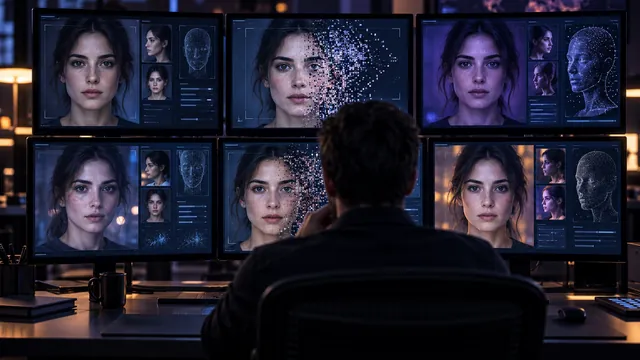
The feature visualization approach has been fundamental to research on AI interpretability, an area that is becoming more relevant as AI applications move into sensitive fields such as facial recognition, automated decision-making, and surveillance.
Another important aspect of Mordvintsev's work is his research on creativity in machines. His work has pioneered so-called "creative AI," an emerging branch of artificial intelligence that seeks to explore whether machines can generate new ideas, concepts, and art forms autonomously. Mordvintsev has worked on building neural networks that not only learn and classify existing patterns but can also generate original content.
This approach has raised philosophical and technical questions about the nature of creativity and the ability of machines to create in ways similar to humans. Although AI has neither consciousness nor emotions, the algorithms developed by Mordvintsev and others have shown that neural networks can generate new forms of artistic expression.
Mordvintsev continues to work at Google, where he keeps developing new ways to explore the capabilities of neural networks, with a focus on improving the transparency of algorithms and their applicability in art. His legacy will be secured not only in the history of AI for his technical contribution, but also for his ability to cross the boundaries between science.