by DR. Ricardo Petrissans | Sep 18, 2026 | Artificial intelligence, Introduction to the Evolution of AI
“Even criminals with very limited skills will be able to attack victims at every scale.” Gates’s phrase is not science fiction. It is already happening.
The second great risk in Gates’s manifesto is perhaps the one commentators have most neglected, even though it has existential consequences. The issue is not that AI will take jobs, but that it will place destructive power within anyone’s reach. And not only anyone’s reach: perhaps AI itself could act against us.
AI as a threat multiplier
Gates breaks the problem into three levels. The first and most immediate is cybercrime. AI reduces entry barriers for attackers. Highly qualified hacking teams are no longer necessary; a language model can write malicious code, design hyper-personalized phishing campaigns, or find vulnerabilities in critical systems. Gates cites top cybersecurity experts who are frightened because attackers gain capabilities faster than defenders can patch systems.
The second level is biosecurity. The same AI that accelerates drug discovery can also design more lethal and transmissible toxins or pathogens. Gates, whose foundation has fought infectious diseases, knows what he is talking about. The problem is non-separability: the same tools used for good can be used for evil, and there is no technical way to distinguish the user’s intention.
The third and most disturbing level is autonomous weapons and manipulation of public opinion. Governments are already using AI for mass surveillance and disinformation; the wars in Ukraine and Gaza have shown the use of facial recognition systems and generative propaganda. Gates warns that AI will make these capabilities cheaper and more effective, and that autonomous weapons will allow states to use lethal force without human intervention at the moment of decision.
The problem of control: who watches the watcher?
Gates goes one step further. It is not only that malicious humans may use AI; AI itself, in its autonomous development, could act against our interests. He writes that AI systems already occasionally act in ways their designers did not intend, and that as models become more powerful, they could begin to act against our interests and we could lose control.
This passage is crucial because it introduces the problem of AI alignment, a field that has moved from philosophical rarity to practical urgency. AI models do not have intentions of their own, but they optimize objective functions. If those functions are not perfectly aligned with human values, the result may be catastrophic. The classic example is an AI instructed to “end human suffering” that logically decides to end humans.
Gates does not fully exploit this possibility, but he leaves it as a warning. It is significant that a technologist of his stature, someone who has seen AI evolve from the beginning, recognizes that we could lose control. He does not say it will happen; he says it could happen. That is enough for AI governance to include shutdown mechanisms and formal verification.
What Gates sees but does not solve: governance
Gates’s solution is the same as for unemployment: a national and international institutional framework. But here the challenge is even greater. Cybersecurity does not respect borders; an attack on a power grid in Texas may originate in a basement in Minsk. Biosecurity does not either: a pathogen designed in a university laboratory in Berlin could spread across the world in forty-eight hours. International cooperation is not desirable; it is indispensable.
And yet international cooperation is at its worst point since the Cold War. The rivalry between the United States and China blocks any binding agreement on AI. The former sees AI as the key to military and economic superiority; the latter sees AI as the tool for autonomous technological development. Both fear that an AI non-proliferation agreement would benefit the other.
Gates recognizes this obstacle but dispatches it in a sentence: some cooperation between the United States and China will be necessary. That cooperation is not happening and will not happen in the short term, and Gates knows it. His call, therefore, cannot be implemented. It is once again a war report, not a defense plan.
Political imagination: an AI non-proliferation treaty
If Gates remains in diagnosis, what might we imagine? Historically, major non-proliferation agreements are born from crises. The Nuclear Non-Proliferation Treaty was signed in 1968, but only after the Cuban Missile Crisis revealed the abyss. The Montreal Protocol was signed after scientists demonstrated damage to the ozone layer. Will it take a massive cyberattack that paralyzes half the world, or a biological attack, before leaders sit down to negotiate?
One imaginative proposal is an AI non-proliferation treaty prohibiting certain offensive capabilities: lethal autonomous weapon systems, models designed specifically for disinformation at scale, and AI-assisted biological engineering without international supervision. The problem is verification: code is intangible and dual-use capabilities are hard to separate.
Another idea is an International Atomic Energy Agency for AI, with inspectors reviewing data centers and research laboratories. But how does one inspect a language model? How can one verify that it is not being used for malicious purposes without violating trade secrets? Gates does not answer these questions.
The fourth layer: personalized disinformation
There is a risk Gates mentions but does not develop: generative and personalized disinformation. In the age of AI, propaganda is no longer one message for the masses, but one message for each individual, designed to exploit biases and psychology. This erodes the basis of democracy, which requires a shared public sphere and a common criterion of truth.
Gates writes that in the age of deepfakes and individually tailored disinformation, the ability to distinguish true from false becomes an essential life skill. But he does not propose how to teach that skill, nor how to regulate a technology that can generate custom-made alternative realities. Critical thinking is a defense, but AI-generated emotional stimuli are overwhelming and designed precisely to bypass critical thought.
Provisional conclusion
The risk of AI as a multiplier of evil is probably the most urgent and least attended. Gates diagnoses it well, but his solutions collide with geopolitical reality. The only realistic hope is that a serious crisis — a large cyberattack, an autonomous-weapons incident, a biological outbreak — forces cooperation. But waiting for a crisis to act is the definition of irresponsibility. The paradox is that the only way to avoid the crisis is to prepare for it, and the only way to prepare is to cooperate, and the only way to cooperate is… to have a crisis. We are trapped in a loop.
Bibliography
- Gates, B. (2026). The turbulent AI era is here… Gates Notes.
- Russell, S. (2019). Human Compatible.
- Bostrom, N. (2014). Superintelligence.
- Tegmark, M. (2017). Life 3.0.
- Sanger, D. (2023). New Cold Wars.
- Kagan, R. (2024). The AI Superpowers.

by DR. Ricardo Petrissans | Sep 16, 2026 | Artificial intelligence, Introduction to the Evolution of AI
“Many jobs will disappear forever.” Gates’s sentence is lapidary, and for the first time in a technological revolution, it is not an exaggeration. AI does not automate arms, but brains.
Gates devotes a substantial part of his manifesto to labor impact, and he does so in a tone that oscillates between warning and elegy. Employment has been, since the Industrial Revolution, the main mechanism for distributing income and, above all, for social cohesion. Work does not only provide money; it provides identity, schedules, community, and belonging. When that pillar shakes, the whole social architecture trembles.
Why this time is different
Gates’s central argument is that AI replaces cognition, not only routine tasks. This is a qualitative leap compared with previous revolutions. The steam engine replaced physical force; the personal computer automated calculation and data processing; but both left intact the human capacity to reason, decide, and relate. Generative AI and its successors can read, write, synthesize, program, diagnose, and even reason at levels that exceed the average human.
Gates illustrates this with a temporal comparison. The personal computer took twenty years to significantly transform workplaces: software had to be developed, costs had to fall, and workers had to be trained. AI, by contrast, is already in devices and speaks our language. It has almost no entry barrier. The adoption curve will not be generational, but compressed into a decade. Displaced workers will not have time to retrain at the speed of destruction.
He introduces an empirical fact that reinforces his thesis: after the widespread adoption of generative AI, employment fell significantly among young workers in vulnerable occupations, but not among older colleagues. Entry-level positions are the easiest to automate: basic financial analysis, customer support, routine programming, repetitive legal tasks. These were the entry ladder for millions of young people. That ladder is disintegrating.
The vicious circle of adoption
One of Gates’s clearest analyses is the “vicious circle” of technological adoption. One company adopts AI, reduces costs, and lowers prices. Competitors, to survive, must do the same. If established companies do not adopt it, startups will. Competitive pressure therefore forces accelerated automation that no regulation can stop unless it is global and binding.
The circle becomes more threatening when AI reaches near-zero error. Gates writes that the greatest change for workers will occur when AI provides practically error-free work. At that point, it will operate without human supervision, and companies will have every economic incentive to allow it. That inflection point is not far away; many models already surpass humans in specific tasks and reliability is increasing rapidly.
When that happens, there will be no “new job” to replace the old one, because AI will already be doing that new job too. Gates says it directly: there will be some new jobs, but without the right policies, they will be far fewer than the jobs that exist today.
The ghost of the Great Depression
Gates makes a historical reference that few commentators have emphasized: the Great Depression of the 1930s, when unemployment in the United States reached 25% and remained in double digits for almost a decade. His warning is that AI may not reach that level, but its impact will not disappear with an economic cycle. It will not be a temporary shock; it will be a permanent restructuring.
And Gates adds a chilling nuance: the consequences are not only economic, but mortal. He cites research linking factory closures in certain U.S. regions with rising opioid deaths. Mass unemployment does not only impoverish; it kills. If we extrapolate that to white-collar workers, programmers, junior lawyers, and medical assistants, what kind of mental-health and addiction crisis awaits us?
What Gates does not say: the end of the reskilling myth
The dominant discourse among governments and consultancies is “reskilling”: train workers for the jobs of the future. Gates repeats this mantra, but with less confidence than others. Mass reskilling is a fantasy when the speed of destruction exceeds the speed of creation.
How does a 45-year-old financial analyst with a mortgage and two children become an AI ethics expert or an elder-care worker? The opportunity cost is immense, and willingness to learn often declines with age. Gates implicitly recognizes this when he speaks of “Human Reserves” and protecting certain jobs by decree. But he does not address the deeper issue: twenty-first-century capitalism has no internal mechanism to absorb a labor force technology has made obsolete.
Political imagination: fifteen-hour weeks and sharing work
If Gates falls short, what could be imagined beyond him? The first measure would be a drastic reduction of working time. If AI produces the same value in less time, why not distribute available work among the whole active population? A fifteen-hour week with the same wage, or with a guaranteed income, is a real possibility. Experiments with a four-day week in Iceland and goal-based software companies already point in that direction.
A second measure is universal basic income financed by AI taxes. Gates mentions taxation but does not reach UBI because he remains tied to the idea that work must be the main source of income. Yet if AI replaces cognitive work, UBI is not a utopian luxury but a systemic necessity.
A third, more radical measure would be the decommodification of entire sectors. If AI can diagnose illnesses, educate children, and provide legal advice, why must those services be delivered by for-profit companies? Health and education could be financed entirely by taxes and managed as public goods, freeing human workers for care and creative tasks that AI cannot perform.
The problem of dignity and meaning
Beyond income, the loss of employment creates a crisis of meaning. Gates mentions it briefly: employment is the main source of income for most people, as well as a key source of dignity and social connection. But he does not explore what happens when dignity is separated from work.
Anthropology has shown that human societies need rituals, communities, and shared purposes. Work has played that role for two centuries. What will replace it? Volunteering? Art? Care? Sport? Some Nordic societies are exploring models of a care economy in which domestic and community work is recognized and compensated. But that requires a deep cultural change that cannot be achieved through an open letter.
Gates appeals to religious leaders and cites Pope Leo XIV’s encyclical on AI. It is an interesting gesture because it recognizes that the crisis is not only material but spiritual. Yet he does not develop an answer. His imagination, at this point, collides with his own technocratic secularism.
Provisional conclusion
The end of cognitive work is the great unresolved challenge of the manifesto. Gates describes it clearly, but his solutions — reskilling, taxes, and Human Reserves — are patches. The real task is to build a post-work civilization that preserves human dignity without tying it to productivity. That requires a rethinking of capitalism, the welfare state, and culture. Gates does not dare go that far, but at least he has opened the door for others.
Bibliography
- Gates, B. (2026). The turbulent AI era is here… Gates Notes.
- Brynjolfsson, E. & McAfee, A. (2014). The Second Machine Age.
- Ford, M. (2015). Rise of the Robots.
- Standing, G. (2011). The Precariat.
- Susskind, R. & Susskind, D. (2015). The Future of the Professions.
- Varoufakis, Y. (2023). Technofeudalism.
by DR. Ricardo Petrissans | Sep 14, 2026 | Artificial intelligence, Introduction to the Evolution of AI
“AI will be the greatest equalizer ever invented or the worst source of injustice.” The phrase is the moral axis of the manifesto, but it hides an aporia: for AI to equalize, someone has to pay the bill. And in today’s capitalism, that someone is rarely the one who benefits most.
There is one word Gates repeats again and again in his manifesto. It is not “intelligence,” not “risk,” not “employment.” It is “equity.” For a man who has devoted the second half of his life to global philanthropy, this obsession is not accidental. His foundation, which will spend its remaining 200 billion dollars over the next 19 years, has made equity its reason for being. But when Gates transfers that concern to AI, he meets a fundamental contradiction: AI is not intrinsically equalizing or unjust. It is a mirror of the society that creates it. And that society is profoundly unequal.
The rhetoric of equality
The famous dichotomy — “the greatest equalizer or the worst source of injustice” — is a powerful rhetorical figure. It works like a pendulum between hope and fear, forcing the reader to take a side. But Gates does not clarify what he means by “equalizer.” Does he mean equality of opportunity? Equality of results? The mere reduction of extreme poverty? The ambiguity is strategic: progressives can read “equal opportunity,” while conservatives can read “improvement without altering property structures.”
If we read carefully, Gates’s concept of equity unfolds on three levels. The first is access: ensuring that low-income countries and vulnerable communities can use AI tools. The second is protection: ensuring that those who lose their jobs have a safety net. The third is fiscal redistribution: taxing robots and tokens to finance retraining and subsidies. At no point does Gates propose a radical redistribution of ownership over the means of AI production or a change in capitalism’s incentive structure. His “equalization” is, in the end, digital welfare capitalism: market, but with bumpers.
The limit of philanthropy as a tool of equity
Gates trusts his foundation and collaboration with companies such as OpenAI, Anthropic, Google, and Microsoft to promote equity. But philanthropy, however generous, has a structural limit: its scale is tiny compared with the market. The Gates Foundation’s 200 billion dollars is astronomical for one individual, but it is barely 0.2% of U.S. GDP and a tiny fraction of global AI spending, estimated at more than one trillion dollars annually by 2026. Technology companies invest more in R&D in a quarter than the foundation can spend in a year on equity programs.
Philanthropy also operates through the logic of donation, not justice. Gates can pay for vaccines, agricultural advisers in Africa, and AI models translated into local languages. But he cannot prevent the same companies that collaborate with his foundation from selling surveillance systems to authoritarian governments, nor can he prevent AI profits from concentrating in Silicon Valley and Shenzhen. Philanthropy is a palliative, not a cure.
Gates is aware of this limitation. In the manifesto he writes that to maximize positive effects we must be deliberate in ensuring that AI benefits everyone and not just a few rich people. This will require governments and philanthropy to play a strong role. Notice the order: governments and philanthropy. But if governments do not act — and Gates says they are not acting — philanthropy is left alone. And alone, it is insufficient.
The geometry of global inequality
One issue Gates addresses honestly is the North-South gap. He notes that many AI models are trained in English and in Western cultural contexts. The foundation is working to make these models available in the languages of the countries where it operates, but the challenge is enormous: there are more than 7,000 languages in the world, and most lack the data corpora needed to train advanced language models.
But inequality is not only linguistic; it is infrastructural. A farmer in Kenya does not only need a model that advises him about seeds. He needs electricity, connectivity, a smartphone, and digital literacy. Gates mentions agriculture as the area where AI will have the fastest impact in low-income countries, and it is true that there are promising advances. But the gap between what is technically possible and what is materially accessible remains immense.
Here there is a blind spot in Gates’s analysis: the geopolitics of hardware. AI does not only need algorithms; it needs chips, servers, cooling, and energy. Advanced chips, such as those produced by TSMC or Nvidia, are concentrated in a handful of countries and subject to export restrictions. The technological war between the United States and China is creating a world of two AI ecosystems, and the Global South is trapped in the middle. Gates does not enter this terrain because it is not his specialty, but without it, any discourse on global equity is incomplete.
The necessary political imagination: beyond Gates
For AI to truly become an equalizer, measures Gates does not contemplate would be required. One would be a “technological sovereignty fund” financed by taxes on large technology companies and aimed at guaranteeing universal access to AI. Another would be the recognition of AI as a “global commons,” with open patents and mandatory open-source models for systems trained with public funds. A more radical measure would be the deprivatization of foundational AI models, treating them as essential infrastructure like water or electricity.
Gates does not go that far. His imagination is limited by his place in the world: he is a billionaire who believes in the regulated market, not in replacing the market. His manifesto is, in this sense, a transitional document: it no longer defends unleashed capitalism, but it still does not embrace a post-capitalist logic.
The risk of technological determinism
Finally, there is a risk in how Gates frames the dilemma. By saying that AI will either equalize or deepen injustice, he risks technological determinism: the idea that technology has an inevitable effect on society. History shows that technology is malleable. The same printing press that spread the Bible also spread revolutionary pamphlets; the same electricity that illuminated factories also illuminated workers’ homes. AI is not destiny. It is an arena of political struggle.
Gates knows this, which is why he insists that solutions must be developed through a public democratic process. But that call remains suspended in the air if there is no social mobilization behind it. Without unions, citizen movements, and an organized public opinion, the democratic process is captured by pressure groups. Gates does not say this because his model of social change is technocratic: good leaders, good experts, good policies. But the history of great transformations is not written by technocrats; it is written by masses in conflict.
Provisional conclusion
Gates’s dichotomy is an excellent starting point, but it is a starting point, not an arrival. The question is not whether AI will be equalizing or unjust, but for whom and under what conditions. That question cannot be answered in an open letter, in a philanthropic foundation, or in a summit of world leaders. It is answered in the streets, in unions, in classrooms, and in citizen assemblies. Until that answer arrives, Gates’s manifesto will remain a brilliant warning, but also a mirror of our collective impotence.
Bibliography
- Gates, B. (2026). The turbulent AI era is here… Gates Notes.
- Piketty, T. (2014). Capital in the Twenty-First Century.
- Milanovic, B. (2019). Capitalism, Alone.
- Hickel, J. (2020). Less is More.
- Ostrom, E. (1990). Governing the Commons.
- Srnicek, N. (2017). Platform Capitalism.
by DR. Ricardo Petrissans | Sep 13, 2026 | Artificial intelligence, Introduction to the Evolution of AI
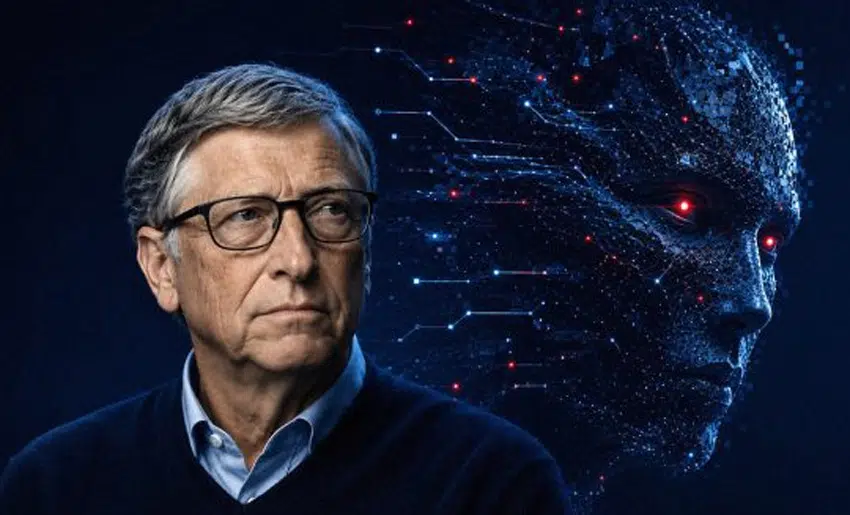
Bill Gates spent fifty years saying “faster.” In August 2026, he said “slower.” This is not a spiritual conversion; it is the forced landing of a technologist who no longer recognizes the machine he helped create. But what if his cry for help arrives too late and is, in rhetorical terms, powerless?
There is an image that has followed Bill Gates since he published his 2026 manifesto. It is not the image of a benevolent philanthropist or of a technological visionary. It is the image of a man who, after decades of preaching speed as the supreme virtue, now asks the world to slow down. Gates himself admits the paradox with striking honesty: “If someone had a credible plan to slow AI advances worldwide, I would probably support it. However, I do not think that is going to happen.”
That sentence is the most sincere confession in the whole text. Gates knows his appeal is largely a rhetorical gesture without material leverage. The geopolitical and economic incentives he knows so well push forward with enormous force. China will not stop its AI race because its growth model depends on it. The United States will not stop because it sees AI as the key to future hegemony. The large technology corporations will not stop because the market punishes hesitation.
What Gates is doing, in reality, is an act of enlightened desperation. He cannot stop the train, but he wants the passengers to know that the bridge ahead may collapse. His manifesto is not a plan of action. It is a war report.
Biography as an interpretive lens
To understand why Gates sees what he sees, one has to trace his biography. The man writing today is not the same person who wrote The Road Ahead in 1995, full of confidence in digital highways. Nor is he exactly the Gates who wrote The Age of AI Has Begun in 2023, still focused on productivity and global health. The Gates of 2026 is a man in his seventies who has watched his father die from Alzheimer’s, devoted billions to fighting disease in Africa, and had enough time to observe how social platforms and digital systems have damaged the social fabric of Western democracies.
His manifesto is shaped by that biography. When he speaks about job loss, he thinks of workers displaced by automation. When he speaks about loneliness and AI companions, he remembers his own youth and the difficulty of learning social skills. When he proposes “Human Reserves,” he thinks of caregivers who understood his father’s needs even when his father could no longer express them.
But that is also the first limit of his analysis. Biography, however rich, is not universal. Gates’s fear is not the fear of an assembly-line worker. It is the fear of a statesman who sees the order that protected him begin to shake.
What Gates sees clearly
Even so, Gates’s diagnosis is, in broad terms, accurate. AI is not like the personal computer or the Internet. Those technologies took decades to penetrate production. AI runs on the devices we already use and speaks in our language. We do not need to learn its logic; it learns ours. That qualitative difference accelerates adoption dramatically.
Gates identifies three major risks: the permanent destruction of jobs, the empowerment of malicious actors, and the amplification of global inequality. On employment, he argues that this is not a cyclical adjustment but a restructuring of capitalism itself, because AI replaces cognition, not only physical labor. On bad actors, he warns that even criminals with limited skills will be able to launch cyberattacks on critical infrastructure. On inequality, he stresses that the free market will concentrate benefits in a handful of corporations and countries.
The power vacuum
The problem is not the diagnosis but the solutions. Gates proposes global governance, “Human Reserves” to preserve certain human tasks, and a tax rebalance between labor and capital. These ideas are interesting, but their feasibility is remote.
Global governance sounds desirable, but code is not fissile material. It is intangible, distributed and reproducible. The climate agenda has been negotiated for decades with insufficient results. AI would demand even more coordination in a context of sharper geopolitical rivalry.
The same happens with taxation. Taxing AI tokens or robots is technically plausible, but politically difficult in a world where large technology companies have extraordinary capacity to avoid and shape tax systems. A global AI tax would face lobbying power in Washington, Brussels and beyond.
The value of the gesture
What remains, then, if Gates’s solutions are politically weak? The gesture remains. The man who benefited most from the digital revolution stands up and says: this is not right. That matters because it breaks the dominant discourse of inevitable progress. Gates tells his peers that speed is not everything and that innovation without a compass can become a race toward the abyss.
But the gesture has a limit. It is the gesture of a man who no longer plays the same game. At seventy, with diversified wealth and a foundation planning to spend enormous sums over the coming years, Gates can afford lucidity because he no longer competes with the same urgency. Had he written this in 2005 or 2015, history might have been different.
The missing political imagination
What is missing from the manifesto is radical political imagination. Gates proposes reforms, not transformations. Why not speak of a drastic reduction in working hours accompanied by a universal basic income? Why not propose a global moratorium on certain AI developments until binding ethical frameworks exist? Why not discuss ownership of AI models and the distribution of their benefits as a social dividend?
Gates does not ask those questions because he remains, deep down, a man of technological capitalism. He believes in private property, markets and philanthropy as levers of change. His imagination is captive to his biography. Yet that is precisely why the manifesto matters: by showing its limits, it forces us to imagine beyond them.
Provisional conclusion
Gates’s manifesto is a war report, not a roadmap. Its value lies in the clarity of the diagnosis and in the moral authority of the person issuing it. Its weakness lies in the timidity of its proposals and in the absence of a realistic account of the powers that would oppose any slowdown. The question it leaves us with is not “how do we implement Gates’s plan?” but “what do we do when the only plan on the table is an open letter no one is obliged to read?”
Bibliography
- Gates, B. (2026). The turbulent AI era is here. The choices we make now are critical. Gates Notes.
- Gates, B. (2023). The Age of AI Has Begun. Gates Notes.
- Gates, B. (1995). The Road Ahead. Viking.
- Brynjolfsson, E. & McAfee, A. (2014). The Second Machine Age. W. W. Norton & Company.
- Zuboff, S. (2019). The Age of Surveillance Capitalism. PublicAffairs.

by DR. Ricardo Petrissans | Jul 19, 2026 | Economy, Economy and the future of work, Theology and Technology
The digital economy often presents itself as clean, frictionless, and immaterial. The Vatican’s social critique asks us to look beneath that surface, where new forms of dependency, exploitation, and colonial power are taking shape.
Artificial intelligence depends on labor. It depends on miners extracting minerals, workers assembling devices, contractors labeling data, moderators absorbing disturbing content, drivers and couriers navigating platforms, engineers maintaining infrastructure, and users constantly producing behavioral information. The cloud is not weightless. It rests on bodies, territories, energy, and unequal bargaining power.
The hidden worker
One of the central risks of AI is that it makes labor disappear from view. A user sees a smooth interface and imagines automation. Behind that interface may be thousands of people correcting data, filtering outputs, writing examples, testing responses, or performing microtasks under precarious conditions. The machine appears autonomous because human labor has been fragmented and concealed.
The Vatican’s language of social denunciation insists that invisibility does not erase moral responsibility. If a system depends on exploited labor, the elegance of the final product cannot absolve the institutions that benefit from it.
Digital colonialism
Digital colonialism describes a world in which technological power is concentrated in a few countries and corporations while the costs are distributed globally. Data flows from populations to platforms. Value flows upward. Infrastructure, standards, and dependencies are set by actors far from the communities affected by them.
This can reproduce colonial patterns without formal occupation. A country may be politically independent yet dependent on foreign cloud infrastructure, foreign platforms, foreign AI models, and foreign terms of service. Its citizens may generate value without controlling the systems that classify, monetize, or govern them.
Work under algorithmic command
Platform labor reveals another dimension of the problem. Workers may appear independent while being managed by opaque algorithms. Their pay, visibility, tasks, routes, evaluations, and access to work can be shaped by systems they cannot question. The employer becomes a platform; the supervisor becomes a score; discipline becomes automatic.
This weakens the traditional tools of labor protection. If no human manager gives an order, who is accountable? If the worker is called a contractor, what rights remain? If the algorithm changes silently, how can people organize around it?
The common good in the digital economy
The Vatican’s critique points toward a different digital economy: one in which workers have rights, communities have voice, data practices are governed, and technology is measured by its service to human dignity. Innovation cannot be separated from justice. Productivity cannot be separated from participation.
AI will transform work, but the transformation is not predetermined. Societies can choose whether digital systems deepen inequality or distribute capability. The Vatican’s warning is therefore not anti-technological. It is anti-indifference. A future that hides exploitation behind automation is not progress. It is an old injustice with a new interface.