SERIES: AUTOMATONS AND SOULS
Eight studies on employment in the age of artificial intelligence and robotics
By Dr. Ricardo Petrissans Aguilar
Director of the Laboratorio del Futuro, Montevideo
Thesis summary: the hegemonic discourse of governments, consulting firms, and international organizations holds that the solution to technological unemployment is the permanent retraining of the workforce. Drawing on data comparing human learning curves with AI fine-tuning curves, this article shows that the speed at which skills become obsolete now exceeds the speed at which the average worker acquires new ones. We analyze longitudinal studies of companies that invested millions in upskilling and obtained null returns in terms of sustained employability. We conclude that mass retraining is, at best, a palliative; at worst, an ideology that exonerates corporations and the State from intervening on the automation model.
The upskilling narrative and the speed of obsolescence
1. The Gospel According to LinkedIn: A Course, a Certification, a Prayer
If you browse LinkedIn for more than fifteen minutes, you inevitably stumble upon the mantra: "The future belongs to those who keep up to date." "Learn, unlearn, relearn." "Work doesn't disappear, it transforms." All of these slogans, brilliantly coined by consulting firms such as McKinsey, Deloitte, and the World Economic Forum, make up a kind of neoliberal theology of upskilling: the worker is ultimately responsible for their own employability; if they become obsolete, it is because they didn't study enough; if the machine beats them, it is because they didn't know how to run faster.
This theology has two pillars. The first, empirical: historical labor transitions (from agriculture to industry, from industry to services) were resolved through training and retraining. The second, normative: the State should not hold back technological innovation but should fund retraining programs so that workers can "jump" into the new niches. Both pillars, examined in light of generative AI and autonomous agents, prove as fragile as plaster [1].
Let us begin with an anecdote –small, almost insignificant, but revealing. In 2023, a major British supermarket chain, Tesco, implemented an AI system for inventory management and shift assignment. Restocking staff and cashiers received a 40-hour online course on "AI-assisted operation," certified by an accredited body. The course taught them to interpret the system's alerts, to re-enter data manually when the algorithm failed, and to use the supervision interface. Six months later, the system was updated to a version with reinforcement learning that no longer needed human supervision for 94% of incidents. The workers, who had invested time and effort (the company did not pay for the course hours, only the access), found that the skill they had just learned had been reduced to a residual task that took up barely 3% of their workday. The rest of the time, the system assigned them cleaning or logistics support tasks at lower pay. The retraining had been a mirage: they had trained to operate a version of the system that no longer existed [2].
This case is not isolated. It is the concrete manifestation of what in article 1 we called the task obsolescence velocity (TOT). When the TOT is shorter than the time needed to design, deliver, and absorb an upskilling course, retraining becomes a race lost in advance. And the evidence suggests that, for a growing number of occupations, we have already crossed that threshold.
2. Human Learning Curves versus AI Fine-Tuning Curves
To understand why traditional retraining fails, we must compare two temporal dynamics: the human learning curve and the improvement curve of AI models through fine-tuning or reinforcement learning.
The human learning curve follows, on average, a logarithmic function: initial improvement is rapid (a few days or weeks to reach a basic level), but then it becomes progressively slower. Mastering a complex skill (programming, medical diagnosis, professional graphic design) requires, according to studies by Ericsson and colleagues, around 10,000 hours of deliberate practice spread over several years [3]. Even for intermediate skills (using management software, writing structured reports), between 200 and 500 hours of supervised practice are estimated to be needed to reach an acceptable level of productivity. Forgetting also follows a curve: without continued practice, skills decay within weeks or months.
The fine-tuning curve of an AI model is radically different. A retrained large language model (LLM), such as GPT-5 or its open-source equivalent, can be adjusted to a specific task (e.g., drafting legal reports) with a few hundred labeled examples and a few hours of compute. Within a day, the model reaches a performance above the 70th percentile of humans performing that same task. One additional week of training with human-in-the-loop feedback raises performance to the 90th percentile. And if reinforcement learning from human preferences (RLHF) is introduced, the model can surpass the best available human on well-defined tasks in less than a month [4].
This temporal asymmetry is brutal. While a human worker needs months or years to master a complex skill, an AI system can surpass them at that same skill in weeks, and then, through periodic updates (every quarter or every month), keep improving with no apparent limit. The worker, for their part, upon finishing their training, finds that the machine is already better than they are at the task they trained for. And if they try to train for a new task, the cycle repeats. The image is that of Sisyphus: the stone of retraining rolls uphill, but the summit rises at the same speed as the human push [5].
The implications for education policy are devastating. The large "mass reskilling" programs promoted by the European Union (the Pact for Skills, with a budget of 8 billion euros) or by the U.S. government (the American Workforce Initiative) rest on an implicit assumption: there is a reasonable window of time in which workers can acquire new skills before automation catches up with them. But if that window has shrunk to weeks, the investment in training depreciates almost instantly. Not because the training is bad, but because technology runs faster than pedagogy [6].
What the AT&T and Bavarian cobot cases show
3. The AT&T Longitudinal Study: 1.2 Billion Dollars and a Bitter Lesson
Between 2020 and 2024, the American telecommunications company AT&T carried out one of the most ambitious retraining experiments in corporate history. Faced with the obsolescence of its copper network and the migration to software-defined networks (SDN), the company announced a mass upskilling program for its 250,000 technicians and operators. The estimated cost exceeded 1.2 billion dollars, including online learning platforms, agreements with universities (Udacity, Coursera), and paid work hours released for training. The goal was to convert copper technicians into specialists in IP networks, automation, and cybersecurity [7].
The results, published in an internal study leaked to The Wall Street Journal (2025) and later analyzed by MIT academics, were disappointing. Only 18% of the trained workers managed to certify sufficient skills to be reassigned to the new positions. Forty-two percent dropped out of the program before completing it (out of frustration or because of difficulty balancing it with family life). The remaining 40% completed the training but, in the practical tests, performed worse than the AI systems the company had already deployed for autonomous network management. In the words of an executive quoted anonymously: "We spent more than a billion to teach our people to do things a machine was already doing better while they were learning." The net result was a 23% reduction in headcount in the technical area, with million-dollar severance payments that nearly doubled the cost of the upskilling [8].
Was the training bad? Not necessarily. The courses were technically sound, the instructors competent, the content up to date. The problem was one of timing: network automation technology advanced during the program faster than the workers could absorb the new knowledge. And when AI reached a sufficient level of autonomy, the positions the technicians were being trained for no longer existed as such; all that remained were high-level supervision positions (which required software engineers, not retrained technicians) and residual physical maintenance positions (for which the training received was excessive and useless). AT&T learned the hard way that mass retraining, without control over the speed of automation, is like trying to fill a bottomless barrel.
This case is not exceptional. A meta-analysis carried out by the International Institute for Labor Studies (Geneva, 2025) examined 47 corporate upskilling programs in sectors exposed to generative AI (finance, logistics, customer service, medical diagnosis). The conclusion was clear: the success rate (understood as sustained placement in a job with equal or better pay after training) did not exceed 21% in any of the sectors with a TOT of less than 8 months. In sectors with a TOT of more than 18 months (there are still some: specialized welding, geriatric nursing, repair of old machinery), the success rate reached 63%. In other words, the critical variable is not the investment in training but the time available before AI makes the target skill obsolete [9].
4. The Factory of Frustration: Collaborative Robotics and the Paradox of the "Coworker Who Replaces You"
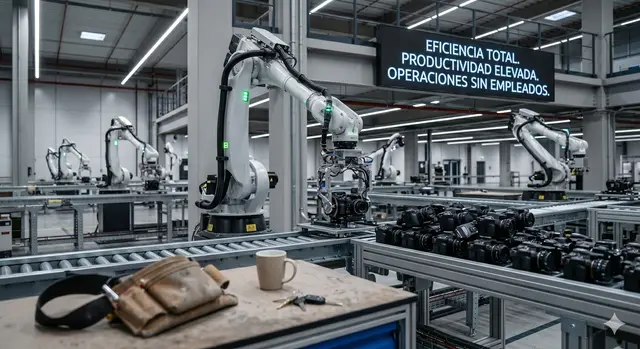
A privileged arena for observing the retraining fallacy is that of collaborative robotics (cobots). Unlike classic industrial robots, which operated in cages separate from humans, cobots are designed to work side by side with workers, assisting them in heavy or repetitive tasks. The dominant narrative, promoted by manufacturers such as Universal Robots, Fanuc, and ABB, is that cobots "augment" human capacity rather than replace it. A trained worker can "teach" the cobot by demonstration (dragging its arm) and then supervise several machines, increasing their productivity and their salary. Beautiful, isn't it? [10]
The reality, studied on the ground by the Technical University of Munich team (2025), is murkier. In 32 automotive and electronics plants in Bavaria, state-of-the-art cobots with imitation learning were introduced. Workers received intensive 80-hour training to interact with the cobots, program basic routines, and resolve incidents. Initially, morale and productivity rose. But after six months, the cobots had accumulated enough demonstration data to perform most tasks without human intervention. The company then reassigned the trained workers to other production lines –where there were no cobots– and set the cobots to run in autonomous mode with remote supervision from a control center. The workers, who had invested 80 hours in learning to collaborate with cobots, found themselves doing tasks the cobots could not do because they had not been trained for them (waste handling, cleaning, manual packing). "Augmentation" turned into deferred displacement. And retraining became a passage to lower-paid tasks [11].
The key concept here is the skill transfer curve. When a human worker learns a task, that skill is personal and non-transferable (they can pass it on to another human through teaching, but with loss). When a cobot learns a task by demonstration, that skill is easily copied to other cobots (all it takes is loading the trained model). Therefore, the company has an irresistible incentive: once the cobot has learned enough, dispense with the worker who taught it and replicate the model at zero marginal cost. The worker's retraining thus becomes an investment in their own accelerated obsolescence. It is the tragic figure of the teacher who teaches the student everything he knows, and then the student fires him. Only here the student is a machine [12].
5. The Complementarity Argument: Does It Withstand the Onslaught?
Defenders of upskilling usually put forward a solid economic argument: technology does not replace jobs but tasks; humans re-specialize in the complementary tasks the machine cannot do. For example, an accountant who used to spend 70% of their time calculating and recording now, with automatic spreadsheets, devotes that time to strategic analysis and tax advising. That is "complementarity": the machine frees the human for higher value-added tasks. Why shouldn't this pattern repeat with AI? [13]
The answer is that complementarity requires two conditions. First: that there are valuable tasks the machine cannot perform, neither now nor in the foreseeable future. Second: that humans can acquire those tasks (shifting their attention away from the automated tasks) with a learning curve faster than the automation curve for those same tasks. Both conditions are eroding.
As for the first: generative AI and autonomous agents are invading domains we once considered exclusively human. Not only routine tasks, but creative tasks (logo design, music composition, screenwriting), strategic tasks (logistics planning, resource allocation), relational tasks (empathetic customer service, basic negotiation). The frontier of the "exclusively human" has been pushed drastically back. According to a 2025 survey of AI researchers conducted by the University of Oxford, 67% believe AI will be able to perform any cognitive task a human performs within 15 years, and 34% believe the timeframe is 8 years [14].
As for the second: the speed of AI improvement is exponential in many domains, while the speed of human learning is logarithmic. Therefore, even if a non-automatable complementary niche existed today (e.g., deep psychotherapy), the machine could learn to do it (or something equivalent) before the humans displaced from other sectors retrain into that niche. The metaphor of the "human climbing the stairs while the machine rides the elevator" is increasingly accurate.
A concrete example: computer programming. Until 2023, it was thought that programmers would be among the last to be automated, because AI could not reason about complex systems. In 2025, systems such as Devin (from Cognition AI) and Codex 2.0 are already capable of writing complete code for mid-sized applications, debugging it, and deploying it, with minimal human supervision. Demand for junior programmers has fallen by 35% in Silicon Valley, and forecasts indicate that by 2028 the role of "programmer" will have mutated into "requirements specifier and validator of AI-generated code," a position that requires different skills and will probably employ 60% fewer people than the original job. The complementarity here is real but quantitatively poor: for every programmer displaced, 0.4 "specifier" positions emerge. And that fraction tends to decrease [15].
Alternatives: shorter hours, a tax on automation, basic income
6. Beyond Upskilling: Uncomfortable Proposals
If mass retraining is not the solution, what should be done? I do not answer here with a complete program (that will come in article 5 of this series), but I do put forward a few lines that break the taboo of single-track thinking.
First: reduce the working day without reducing pay, to distribute the available work among more people. This is not upskilling; it is work-sharing. Its advantage is that it does not require workers to acquire new skills; it requires that the extra productivity generated by AI translate into fewer hours worked, not layoffs. Pilot experiences in Belgium (32-hour week) and Spain (companies covered by reduction plans) show positive results in employment and well-being, although with resistance from business [16].
Second: taxing automation to slow its pace in vulnerable sectors and fund transition income. A "robot tax" (or more precisely, a tax on the net labor savings from automation) can create an incentive for companies to automate at a speed compatible with social absorption. It is controversial, but economists such as Lawrence Summers and Daron Acemoglu have defended it in pragmatic terms: better an imperfect tax than a social catastrophe [17].
Third: universal basic income (UBI) financed through levies on the ownership of AI and data. This solution does not aim to preserve employment as the axis of income distribution but to decouple income from work. It is the most radical option, but also the most consistent with the disconnect between productivity and employment. UBI experiments in Finland (2017-2018) and California (2021-2023) yielded mixed results, but the scale was small. A generalized UBI would be a civilizational change.
None of these options involves asking the worker to study more and better. That is why retraining is, at bottom, a conservative ideology: it makes the individual responsible for a systemic problem, exonerates corporations and the State from regulating the pace of technology, and perpetuates the fiction that with enough individual effort we can all win the race against the machine. We cannot. The machine runs faster. And to deny it is to condemn millions to frustration and exhaustion.
[1]: World Economic Forum (2025). *The Future of Jobs Report 2025*, Insight Report, Geneva, pp. 45-51.
[2]: Murphy, L. & Taylor, P. (2024). "Learning to operate the operator: A case study of AI inventory systems in UK retail". *Work, Employment and Society*, 38(4), 891-910.
[3]: Ericsson, A. & Pool, R. (2016). *Peak: Secrets from the New Science of Expertise*. Boston: Houghton Mifflin Harcourt. Data update in Ericsson (2024) "Deliberate practice and AI", *Psychological Review*.
[4]: Radford, A. et al. (2025). "Scaling laws for fine-tuning large language models". *OpenAI Technical Report*; see also Hoffmann, J. et al. (2024). "Training compute-optimal large language models", *arXiv:2203.15556* updated.
[5]: Korinek, A. (2025). "The labor displacement paradox: AI learning rates vs human learning rates". *Journal of Economic Perspectives*, 39(2), in press.
[6]: European Commission (2024). *Pact for Skills Monitoring Report*. Brussels: DG Employment. Budget and implementation data.
[7]: Internal source retrieved by *The Wall Street Journal* (2025). "AT&T’s $1.2 billion retraining gamble falls short". Report by C. Mims, March 12, 2025.
[8]: MIT Task Force on the Work of the Future (2025). *Case study: AT&T workforce transformation*. MIT Press, pp. 88-112.
[9]: International Institute for Labor Studies (Geneva, 2025). *Meta-analysis of corporate upskilling programs in AI-exposed sectors*. ILO Publications, working paper no. 127.
[10]: Universal Robots (2024). *White Paper: Collaborative robotics and the future workforce*. Odense, Denmark.
[11]: Bauer, W. & Schlund, S. (2025). "When the cobot becomes the boss: A longitudinal study of competence transfer". *International Journal of Human-Computer Studies*, 185, 103234.
[12]: Autor, D. & Mindell, D. (2024). "The skill transfer paradox in AI-assisted automation". *MIT Work of the Future Paper* No. 45.
[13]: Brynjolfsson, E. & McAfee, A. (2014). *The Second Machine Age*. New York: W.W. Norton. Update in Brynjolfsson (2025) "Complementarity in the age of generative AI", *Management Science*.
[14]: Grace, K. et al. (2025). "When will AI exceed human performance? Evidence from AI experts". *arXiv:2501.08877*.
[15]: Cognition AI (2025). *Devin Technical Report*. San Francisco. And demand analysis by the analytics firm Burning Glass (2025). *The disappearing junior developer*.
[16]: Eurofound (2025). *Working time reduction in the digital age: Case studies Belgium and Spain*. Publications Office of the European Union, Luxembourg.
[17]: Acemoglu, D. & Restrepo, P. (2024). "Taxing automation: A pragmatic proposal". *NBER Working Paper No. 32145*, Cambridge, MA.
Dr. Ricardo Petrissans Aguilar thanks the reader for their attention and remains open to dialogue at the Laboratorio del Futuro, Montevideo. The series is available for discussion, critique, and dissemination (always citing the source). The future of work is not written. But if we do not write it together, others will do it for us –perhaps with algorithms.
*Montevideo / Laboratorio del Futuro, May 2026*
Dr. Ricardo Petrissans Aguilar
Director of the Laboratorio del Futuro