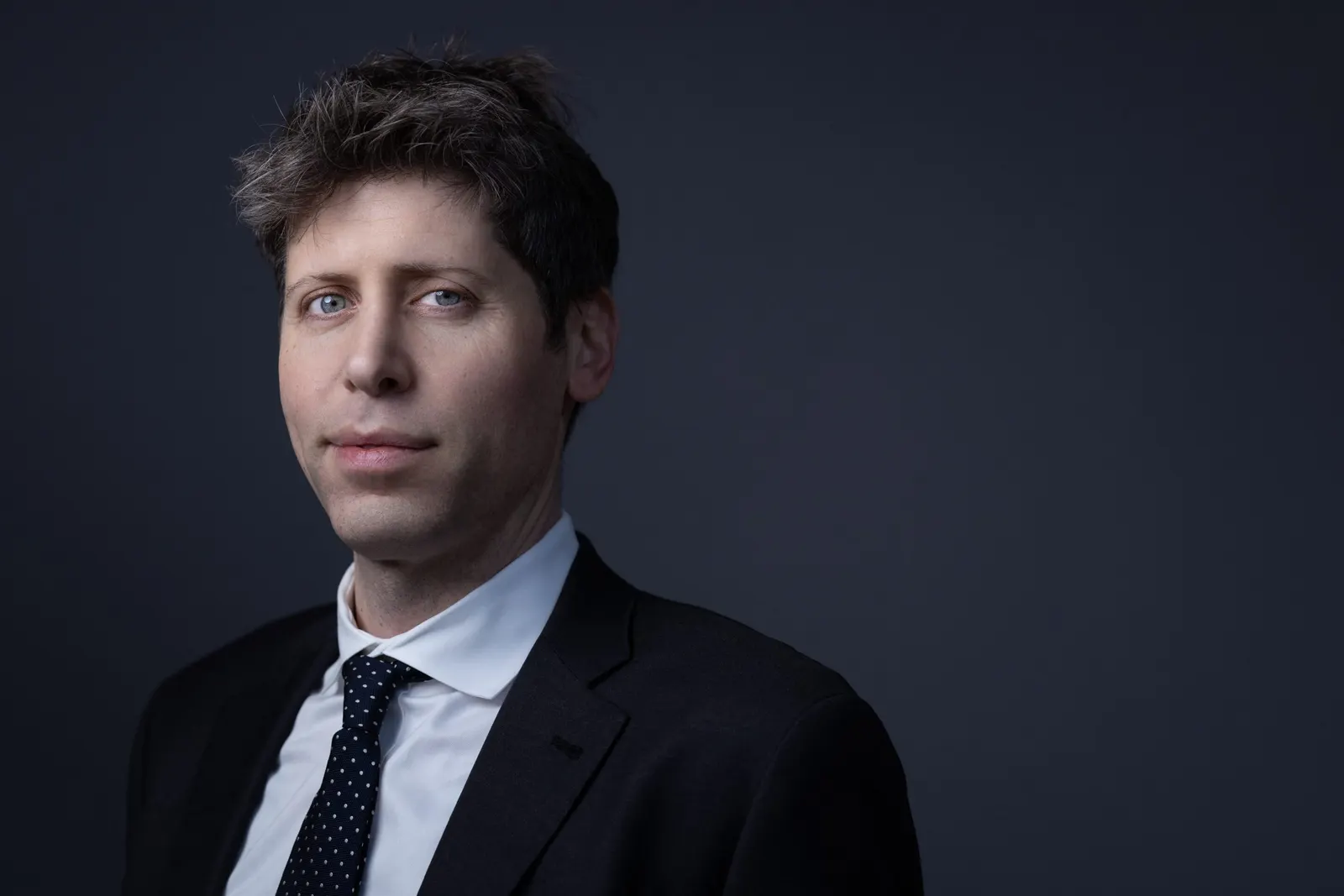
OpenAI's CEO took the stage at the world's largest asset manager and said something that should chill us to the bone: artificial intelligence is changing capitalism. He didn't say it as a warning. He said it as a fait accompli, with the same ease with which a conqueror announces that the territory is already his.
I. The Stage and the Preacher
Some places are not neutral. BlackRock's infrastructure summit is one of them. It is not an academic conference, not a debate forum, not a space where ideas are explored with the freedom that comes from being ignorant of the consequences. It is, instead, the throne room of global financial capital. BlackRock manages more than ten trillion dollars. Ten trillion. That figure is not understood the way the figures of everyday life are understood. It is an abstraction that nonetheless decides what gets built, what gets abandoned, which companies live and which die.
There, on that stage, Sam Altman was not invited as a technician explaining a tool. He was invited as a prophet bringing a gospel. And the gospel, like every gospel, has an unmistakable structure: it promises salvation, demands sacrifices, and places its priests in a position from which they cannot be argued with.
What Altman said at BlackRock is not an economic analysis. It is a manifesto. And like any self-respecting manifesto, it has a deceptive beauty: the beauty of simple ideas that promise to solve complex problems with a single wave of the hand. Scarcity to abundance. Work to supervision. Capital to public service. They sound good. Too good.
But here, we are going to read between the lines. We are going to ask who is speaking, from where they speak, to whom they speak, and, above all, what goes unsaid.
The promise of the end of scarcity and its limits
II. The End of Scarcity: A Promise with a Catch
The central idea of Altman's speech is as old as utopia: technology will free us from scarcity. For millennia, he says, humanity organized its societies around the limitation of resources. Now, artificial intelligence, that capacity to produce thought massively and cheaply, breaks that paradigm. We are entering the era of abundance.
It is a beautiful idea. It is also an idea we have heard before. The Industrial Revolution promised abundance and brought factory slavery, sixteen-hour workdays, children with hands mutilated by machines. The computing age promised to democratize knowledge and brought monopolies that know more about us than we do ourselves. Every great technological leap has been presented as the exit door from scarcity. And every time, scarcity has reconfigured itself, moved to a different place, but not disappeared.
Because scarcity is not only physical. It is also political. Scarcity is the mechanism through which power is distributed. When Altman says that intelligence will become "too cheap to meter," he is describing a world where access to cognitive capacity will be universal. But who controls the data centers? Who decides what is trained and what is left out? Who sets the limits of that intelligence offered like water?
Water, to use his own metaphor, is not a neutral public service. Water gets privatized, contaminated, rationed. In many parts of the world, water is a battlefield. Turning intelligence into a public service is no guarantee of democratization; it is, if anything, an invitation to ask who will be the water company, who will install the meters, and who will cut off the supply when the bill goes unpaid.
III. The Worker Who Disappears: The Uncomfortable Confession
There is a moment in Altman's speech that deserves a pause. Not for what he says, but for the way he says it. He talks about his own role at OpenAI: "My job went from doing direct technical work to managing a team of agents that do this work." He describes it casually, almost with pride. He is a man who has stopped doing in order to devote himself to supervising. And he presents it as the model of the future.
But the confession has a flip side that Altman does not mention. If he went from doing to supervising, how many others will make the opposite journey? How many will go from having a job to having none? Altman puts it bluntly: artificial intelligence lets the owners of capital depend less on direct human effort. It is a sentence that should stop any conversation in its tracks. Because he is saying, out loud and in front of the owners of capital, that the social pact that sustained the twentieth century (work in exchange for wages, wages in exchange for consumption, consumption in exchange for stability) has come to an end.
It is not a prediction. It is a diagnosis. And the diagnosis, coming from whom it comes from, is a sentence.
Altman knows that the mass layoffs corporations attribute to AI often have more prosaic causes: financial pressure, margin maximization, the immutable logic of capital seeking to cut costs wherever possible. But he says it like someone pointing out an anecdote, not like someone denouncing a symptom. Because for him, the underlying phenomenon, the replacement of human labor by artificial intelligence, is inevitable. And if it is inevitable, there is no point lamenting it. It is worth managing it.
There lies the ethical core of the problem. Altman does not present himself as someone causing a change whose consequences he does not know. He presents himself as someone who knows, who announces it, and who nevertheless carries on. There is a word for that. I am not going to use it here. But it is on the table.
Data centers, 2028, and the regulation Altman concedes
IV. Infrastructure as a Weapon: Data Centers That Look Like Spaceships
Altman asks the BlackRock attendees to imagine the inside of a hyperscale data center. He says it looks like a spaceship. It is no casual metaphor. It is an image of power. A spaceship is not just a place; it is a symbol of something beyond the reach of ordinary mortals, something that belongs to the few who can afford the trip.
AI infrastructure is, according to Altman, the absolute priority. And he is right about one thing: without it, there is no artificial intelligence. But the way he describes that infrastructure reveals the true nature of the project. He talks about multibillion-dollar investments before they are profitable. He talks about geopolitically vulnerable supply chains. He talks about competition with China. What he does not talk about is who will pay the environmental cost of those data centers: the water that cools the servers, the electricity that powers them, the minerals extracted from devastated territories to make the chips.
AI infrastructure does not float in a vacuum. It sits on territories, consumes resources, leaves footprints. Altman knows this. But in his speech, those costs disappear, just as the workers who will no longer be needed disappear. What remains is the spaceship: clean, shiny, promising. And the message to investors is clear: climb aboard before it is too late.
V. 2028: The Year Machines Will Think More Than We Do
Altman proposes two milestones for measuring progress toward artificial general intelligence (AGI). The first is quantitative: by the end of 2028, there will be more cognitive capacity inside data centers than outside them. Machines, taken together, will think more than all of humanity combined. The second is political: when a CEO or a president cannot do their job without intensive use of AI.
Both milestones are framed as if they were inevitable. Not as if they were choices. Not as if they were the result of decisions someone makes and someone else could challenge. In Altman's rhetoric, they are natural phenomena, like gravity or photosynthesis. Artificial intelligence will reach that point just because, because technology advances, because there is no alternative.
But there is an alternative. There always is. The alternative is to decide collectively what kind of technology we want, at what pace we introduce it, with what safeguards, with what counterweights. The alternative is to ask ourselves whether we want to live in a world where presidents cannot govern without consulting a machine. The alternative is to ask what kind of democracy survives when the power of decision is mediated by systems that only a few understand and that no one really controls.
Altman mentions the need for regulation and democratic processes. But he does so like someone granting a gesture, not like someone facing a problem. He says AI development must be subject to the popular will. But he does not say how that is done when the industry moves at a speed that outpaces the response capacity of legal frameworks. He does not say how that is done when the very governments that should regulate are the first to use AI to make decisions. He does not say how that is done when citizens do not understand what is at stake because the language of technology has become a closed dialect, accessible only to initiates.
Capitalism without work and technological image-washing
VI. The Paradox of Capitalism Without Work
There is a contradiction in Altman's speech that he himself seems to recognize without resolving. If artificial intelligence displaces the value of human labor, how will people earn an income? How will an economy work in which most people produce no value because production is in the hands of machines?
Altman has no answer. He talks about the need to "redefine how people earn their income," but offers not even a sketch of that redefinition. And he does not offer one because, in all likelihood, he does not have one. Because the model he is describing (abundance capitalism, he calls it) is a model where the relationship between capital and labor breaks, but is not replaced by anything.
It is the old dream of the owners of capital: to make profits without having to share them with those who do the work. But the dream has a problem: if there are no workers with wages, there are no consumers with purchasing power. If there are no consumers, there is no market. If there is no market, profits evaporate. It is the contradiction Marx pointed out a century and a half ago, and which capitalism has never been able to fully resolve. Altman has taken it to its extreme: a capitalism that dispenses with workers is a capitalism that, in the long run, dispenses with itself.
Altman knows this. That is why he talks about deflation, falling prices, services that become marginal in cost terms. But deflation is not a solution; it is a symptom. It is the mirage of abundance that hides the reality of concentration: a few will have the data centers, the chips, the energy, the models. The rest will have cheap access to an intelligence they no longer need to use because there is no longer any work to do with it.
VII. Technological Whitewashing
Altman points out, with a disarming honesty, that many companies are using AI as an excuse for layoffs that in reality respond to traditional financial pressures. He calls it technological "whitewashing." And he is right. But in saying so, he puts himself in an uncomfortable position: he is the leader of the company that makes the tool that serves as the excuse.
This is no minor detail. Because if companies lay off workers claiming that AI makes them unnecessary, but are in reality doing it to increase margins, then AI is not the cause of those layoffs. It is the pretext. And the pretext is possible because Altman and his industry have built a narrative according to which the replacement of human labor is inevitable. They have created the prophecy and are fulfilling it at the same time.
There is a word for that too. But we will leave it where it is.
The water metaphor and the silence of those affected
VIII. The Water Metaphor: A Public Service That Poisons
Altman wants intelligence to be like water: a public service, cheap, metered, accessible to all. It is a powerful metaphor. But it is also a tricky one.
Because water is not only a public service. Water is, in Flint, Michigan, the poison that poisoned an entire city because some politicians decided to save money by changing the supply source. Water is, in the western United States, a resource over which farmers fight with cities, cities with corporations, corporations with states. Water is, in northern Chile, what mining companies pull from the aquifers while communities are left with nothing to drink.
Turning intelligence into a public service does not resolve the fundamental question: who controls the service? Who sets the rates? Who decides what it is used for and what it is not? Who guarantees that it does not become an instrument of control rather than an instrument of liberation?
Altman does not answer these questions. And he does not answer them because, in all likelihood, his audience would not like the answers. The BlackRock audience is not interested in democratically managed public services. It is interested in profitable infrastructure. And artificial intelligence, in Altman's model, will be profitable. Not for everyone. For those who own the data centers.
IX. The Silence of the Affected
There is something that does not appear in Altman's speech. Something that should be at the center of any conversation about the future of work, the distribution of wealth and the role of technology in society. Not a single affected person appears. Not a single worker who has lost their job. Not a single community that has watched its industry disappear. Not a single voice that is not that of investors, CEOs, presidents who will not be able to govern without AI.
That silence is no accident. It is structural. Because Altman's speech is not meant to be heard by the affected. It is meant to be heard by those who make the decisions. And in that closed circuit (companies that invest, governments that facilitate, investors that finance) there is no place for those who do not have a seat at the table.
But we, from the outside, can hear what is not said. We can read between the lines. We can ask what it means that a man, at a summit of the world's largest asset manager, announces the end of the era of work as if he were announcing the weather. We can ask what kind of society we are building when intelligence becomes a public service managed by the same people who today manage financial capital.
And we can, above all, refuse to accept that this future is inevitable. Because it is not. Technology is not a meteorite falling from the sky. It is the result of human decisions. Decisions made in places like BlackRock, yes. But also decisions that can be challenged, resisted, redirected.
X. Conclusion: The Prophet and His Wares
Sam Altman is an intelligent man. There is no doubt. He knows what he says and he knows to whom he says it. His speech at BlackRock is a masterpiece of rhetoric: it combines utopian promise with realistic warning, the confession of problems with the assurance that there is no alternative, the appeal to democracy with the certainty that democratic processes are too slow to keep up with the pace of innovation.
But intelligence is not innocence. Altman knows his business model depends on the concentration of power in the hands of a few. He knows AI infrastructure will not belong to everyone, because not everyone makes multibillion-dollar investments. He knows the transition from scarcity to abundance will leave deep wounds in millions of people who have no voice in his speech.
And yet he carries on. Not because he is evil. Perhaps because he truly believes that what he is doing is good, necessary, inevitable. That is the most dangerous form of power: the kind exercised with the conviction of being on the right side of history.
We, from our small table, from our conversation that has crossed twelve volumes and thousands of pages, can do something Altman does not expect: we can read his speech the way one reads a document of power, with the lens of Gracián, the patience of Tacitus, the distrust of Machiavelli. We can see the seams, point out the silences, name what goes unsaid.
We are not going to stop artificial intelligence. That is not the purpose. But we can refuse to accept that the only possible future is the one presented to us by the prophets of BlackRock. We can insist that technology, like water, must be a common good, managed collectively, with rules that protect the most vulnerable before the most powerful.
We can, above all, remember that an abundance of intelligence means nothing if it is built on the poverty of humanity. That a world where machines think more than we do may be a world richer in data but poorer in dignity. That true abundance is not the kind measured in teraflops, but the kind that allows every person to live with meaning, with work, with community, with hope.
Altman sells water. But the water he sells is not the water that springs from the common fountain. It is the water that comes out of his tap. And the tap, like all taps, has a meter. And the meter, like all meters, has an owner.
We, meanwhile, are still here. That is not nothing. It is, perhaps, the only thing worth doing.
Author's note: This article was written from Sam Altman's speech at the BlackRock infrastructure summit, March 2026. The interpretations and criticisms expressed here are the author's responsibility and do not necessarily represent the opinion of the publication in which it is distributed.