Series: Laboratorio del Futuro – Voices Building Tomorrow
Five voices. Five views on the future of work. From Musk's utopia to Hinton's warning, by way of Amodei's alert, Altman's reorganization and Li's humanization.
The laboratory of the future is not a place with robots assembling boxes. It is a space for debate, for collective decision-making, for building institutions. Because in the end, the question about work is not a technical question. It is a question about what kind of society we want to be.
And as Hinton said, the answer is not in the laboratories. It is in all of us.
Elon Musk: "Work as a Garden, Not as an Obligation"
The Forum Scene, Washington, D.C.
The stage was sober, almost minimalist. Two black leather armchairs, a low table with bottles of water and, in the background, a giant screen projecting the logo of the U.S.-Saudi investment forum. It was November 2025, and the room was full of the most powerful fund managers on the planet. Men and women who moved sums of money most mortals cannot imagine listened with the attention of someone attending a master class on the future.
On the left, Jensen Huang, CEO of NVIDIA, the man who manufactures the bricks from which artificial intelligence is built. On the right, Elon Musk. He needed no introduction. His slender figure, his black shirt, his nervous but contained energy. When he began to speak, he did not talk about quarterly results or stock market valuations. He talked about something deeper: what it means to be human in a world where machines do everything.
"In ten or twenty years," said Musk, with that mix of precision and distance in his gaze, "work will be optional. It will be like playing a sport or a video game. If you want to work, you will do it because you enjoy it, but not because you need to in order to survive."
The room held its breath. It was not the first time Musk had made bold predictions, but this one, said in that forum, in front of those investors, sounded different. It sounded like a road map, not science fiction.
Barely two months later, in January 2026, Musk would do it again. This time in Davos, before the World Economic Forum, seated next to Larry Fink, the man who manages more than ten trillion dollars at BlackRock. There, among the snowy peaks of the Swiss Alps, Musk sketched a world with more robots than people, an "unprecedented economic explosion" and the promise that technology could, at last, free humanity from the age-old slavery of forced labor.
Optional work: Musk’s vision
The End of Necessity
To understand Musk's vision, we have to stop thinking of work as we have known it for centuries. Since the Industrial Revolution, most people's lives have revolved around a single axis: selling our time and our energy in exchange for a wage. That transaction, which we call work, is not just a source of income. It is also a source of identity. When we meet someone, the first thing we ask is: "What do you do?"
Musk suggests that this question may become irrelevant.
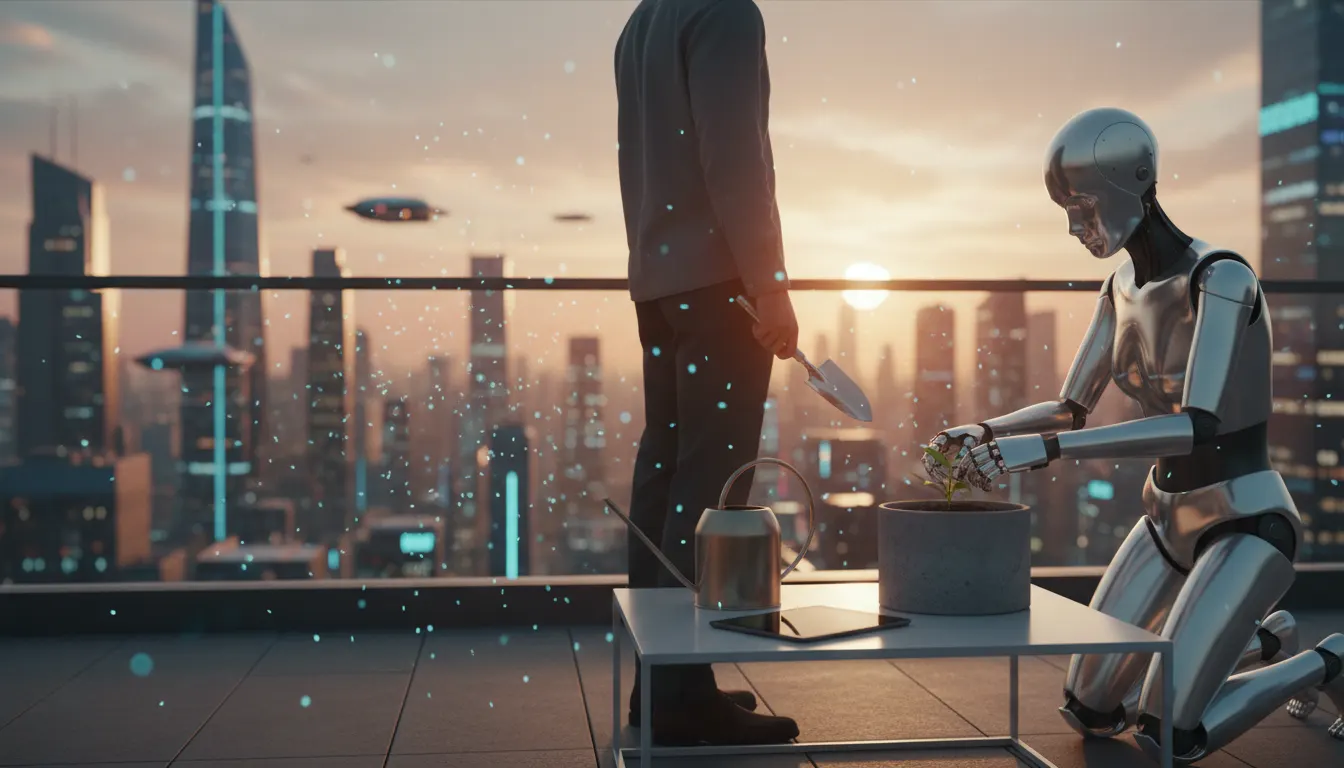
In his remarks at the Washington forum, he used a powerful metaphor. He compared the work of the future to the act of growing vegetables. Today, if someone wants tomatoes, they can buy them at the supermarket for a few euros. But they can also decide to plant them in their garden, water them, tend them and harvest them. They don't do it out of necessity (the supermarket tomatoes are cheaper and require less effort) but for pleasure, for the satisfaction of watching something grow with their own hands.
That, according to Musk, will be work in the future. A voluntary, chosen, pleasurable activity. The equivalent of playing tennis or going hiking. Something done just because, because it is part of who we are, not because our survival depends on it.
"It will be like playing sports or a video game," Musk insisted. "If you want to work, you will do it because you enjoy it, but not because you must do it to survive."
Material Abundance and Its Literary Roots
Behind this vision lies a radical economic idea: abundance. Musk believes that the combination of artificial intelligence and robotics at scale can produce all the goods and services humanity needs so cheaply and efficiently that the very concept of scarcity, the foundation of all classical economics, will cease to make sense.
To illustrate this idea, Musk turns to science fiction. Specifically, to the novel series The Culture by the Scottish writer Iain M. Banks. In that literary universe, humanity has created artificial intelligences so powerful that they take care of all material production. Ships, cities, consumer goods, everything is generated by machines. Humans, freed from the need to work, spend their time exploring, creating art, relating to one another, living. Money has disappeared because it is no longer needed: why exchange goods when there is infinite abundance for everyone?
Musk does not mention this work merely as a literary curiosity. He presents it as a possible model of social organization. A horizon toward which we could head if technology develops in the right way and, above all, if the benefits of that abundance are distributed so that they reach everyone.
In Davos, he went even further. There he predicted that the number of robots and AI systems will exceed the human population. He spoke of humanoid robots, such as Tesla's Optimus, which are already performing simple tasks in factories and could soon be in homes, looking after children or pets, as long as their safety is guaranteed.
"Who wouldn't want a robot, assuming it is very safe, to watch their kids or look after their pets?" Musk asked, sketching a world where automation not only produces wealth but also takes care of what we love most.
What it takes to get there: robots, energy, and longevity
The Road to Abundance: Robots, Energy and Longevity
But how do we get from here to there? Musk is not just a visionary; he is also an engineer. And as an engineer, he has a plan, or at least an idea of the components needed.
The first is humanoid robots. His company Tesla has spent years developing Optimus, a robot designed to perform repetitive and dangerous tasks in factories, but with its sights set on the home market. According to his predictions, by the end of 2026 these robots could be performing complex industrial tasks, and soon they could go on sale to the general public.
Musk has gone so far as to claim that, within a decade, Tesla's robots could outnumber human surgeons and offer medical care superior to what anyone receives today, including heads of government.
The second component is energy. Musk has insisted for years that the future of AI is tied to the future of solar power and batteries. In his vision, the combination of clean, abundant energy with artificial intelligence will make it possible to power a civilization of robots that produce without limit and without environmental cost.
The third component, perhaps the most surprising, is longevity. For Musk, aging is a "very solvable problem." In his remarks, he has suggested that death is nothing more than a biological program that can be rewritten. "You're preprogrammed to die. So if you change the program, you'll live longer," he said on a recent podcast. In Davos, he went further: he described aging as a problem whose biological cause, once identified, will turn out to be "incredibly obvious" to scientists.
The underlying idea is consistent with the rest of his vision: if technology can solve the scarcity of goods, why couldn't it also solve the scarcity of time?
Universal Income as a Bridge
Musk is not naive. He knows that the transition from today's world to that future of abundance will be neither automatic nor simple. That is why, like other tech leaders, Sam Altman, CEO of OpenAI, among them, he has voiced support for the idea of a universal basic income.
The logic is simple: if automation destroys jobs faster than new ones are created, many people will be left without income. Before total abundance becomes a reality, a redistribution mechanism will be needed to ensure that no one is left behind. A high universal income, funded by the profits of automation, would allow people to cover their needs while society reconfigures itself.
On the farthest horizon, when scarcity has disappeared entirely, money itself would lose its relevance. But until then, a basic income would be the bridge between the world of compulsory work and the world of work as a garden.
The objections: costs, gaps, and political decisions
The Critical Voices: The Other Side of Abundance
Naturally, not everyone shares Musk's optimism. Economists such as Ioana Marinescu, a professor at the University of Pennsylvania, point out that robotics is still costly and hard to scale, especially outside the digital realm. Business adoption of physical automation has not expanded at the pace Musk predicts.
Other analysts warn that, so far, the AI revolution has widened the gap between those who have access to the technology and those who do not. Abundance does not distribute itself; it requires political decisions, regulatory frameworks, and institutions that ensure the wealth generated is not concentrated in a few hands.
Musk himself implicitly acknowledges these challenges when he speaks of the need for robots to be safe, for energy to be abundant and for a universal income to exist. He is not naive; he is a man who has devoted his life to building the future and who, like all builders, knows that blueprints do not always match reality.
The Garden and the Gardener
Let us return to the image of the garden. Musk invites us to imagine a world where working is like planting tomatoes for pleasure. It is a beautiful, almost bucolic image. But it is worth remembering that gardens do not grow on their own. They require care, attention, decisions about what to plant and what to pull up. Above all, they require a gardener.
In Musk's future, that gardener is not a robot or an artificial intelligence. It is society as a whole. Politics, ethics, the capacity to decide collectively what kind of world we want to inhabit. Technology can create abundance, but it cannot create meaning. That, like the pleasure of growing tomatoes, remains up to us.
Musk knows this. That is why, when he speaks, he does not talk only about robots and algorithms. He talks about what it means to be human. And he leaves us with a question that, like all important questions, has no easy answer: if the machine does everything, what will we do? Will we be up to a world where the only thing left is to choose?
In the next article in the Laboratorio del Futuro series: we will delve into the vision of Dario Amodei, CEO of Anthropic, who warns of the silent tsunami coming for white-collar jobs. We call it "The Silent Tsunami: Dario Amodei and the Disappearance of the Front Line".