Research series from Laboratorio del Futuro
I. The phrase that ends every debate
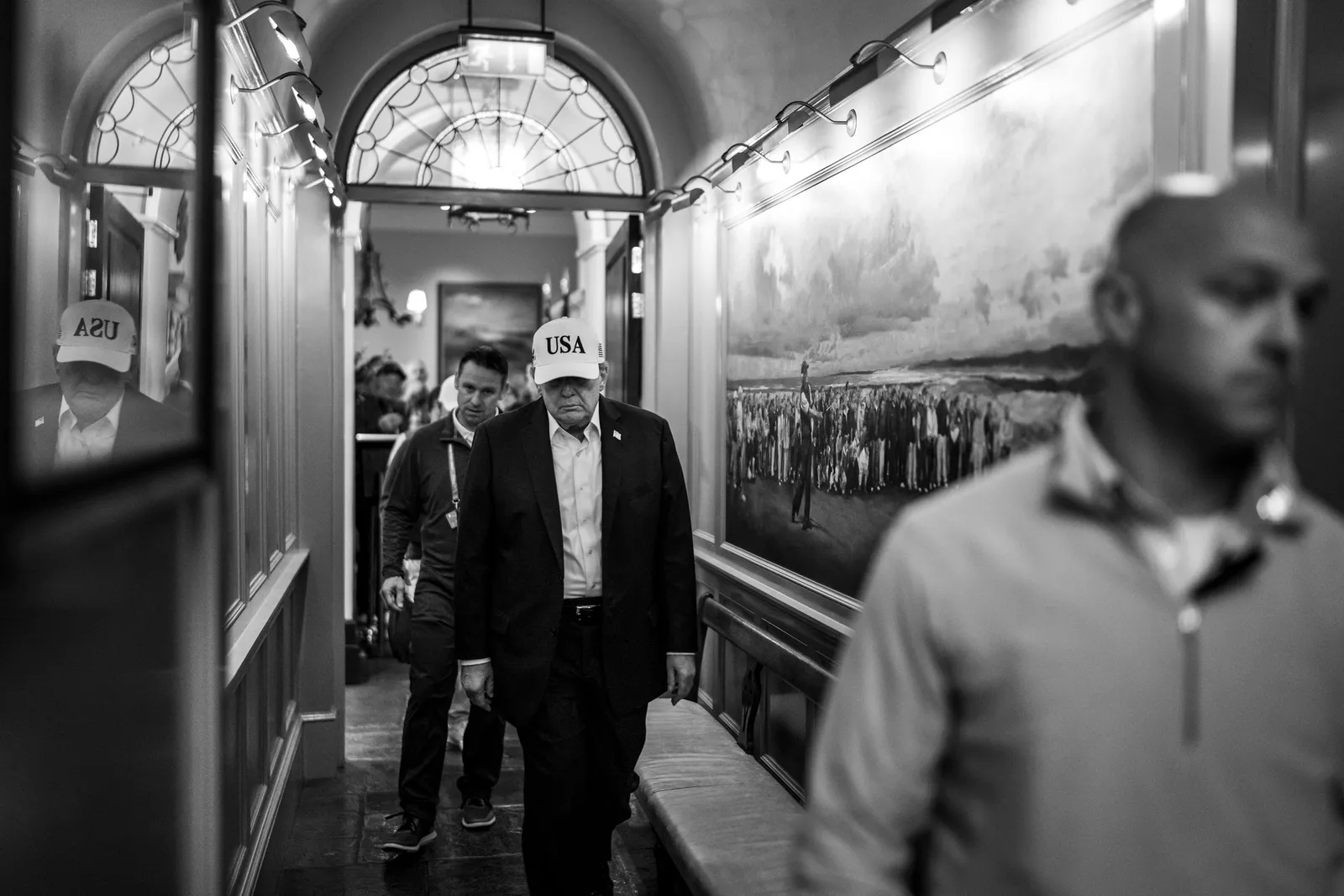
There is a phrase Donald Trump has repeated in every public appearance on artificial intelligence, and it works like a master key that shuts down any discussion before it begins. He said it at his golf course in Ireland, while the CEOs of Anthropic, OpenAI and xAI were publicly asking him to slow development down. He said it at the White House, surrounded by the executives who had just signed his "morally binding" agreement. He said it at the UN, on the campaign trail, on Truth Social. And it is always the same: "Whoever wins AI, wins".
The phrase works because it leaves no room for the opposite question. It does not say "we must win". It says "whoever wins, wins". It is a tautology dressed up as strategy. And its function in the debate on AI safety is precise: it shifts the discussion from risk to power. The question is no longer whether AI is dangerous, but who controls it. And in that logic, whoever proposes slowing down is not prudent: they are a naive fool handing the future to a rival.
This article is about that: how geopolitical competition has become the perfect argument for regulating nothing, and why that argument is more dangerous than it looks.
II. The rival who never slows down
The argument has a simple structure. Every time someone proposes a pause, a binding standard or a moratorium, the same objection appears: the rival will not stop. If we slow down and they do not, we lose the race. And if we lose the race, we lose everything else: the economy, security, global influence.
The objection is not new. It is the same one used during the Cold War to justify the nuclear race, the space race and the missile race. And it has the same property it had then: it is irrefutable on the surface and empty underneath. On the surface, it is true that the rival will not stop if we slow down. Underneath, the question nobody ever asks is: what if the rival does not stop when we do not slow down either? What if the race has no finish line, and the only result of running faster is reaching the same abyss sooner?
Dario Amodei, the Anthropic CEO who in September 2026 publicly called for "slowing the pace" of development, is fully aware of this tension. In his essay We Must Pace the Frontier, he wrote that any slowdown would have to happen "without sacrificing America's commercial edge or leadership in AI". And he added: "If slowing down bought us even an extra year or two before models reach critical levels of capability, and we used that time to make progress on alignment, we could greatly reduce the risk of something going seriously wrong".
Read that sentence carefully. Amodei is not asking to stop AI. He is asking to buy time. And to buy time without losing the race, he needs every competitor to slow down at the same pace. But nobody can verify that the others are slowing down. And whoever slows down first, loses.
III. The prisoner's trap at industrial scale
The logical structure of this argument is that of a prisoner's dilemma, with one crucial difference: in the classic dilemma, the one who confesses goes to prison. In this version, the one who confesses wins the market.
Amodei said it with a frankness that disarms any accusation of naivety: "If I'm off by a year on that growth rate, I go bankrupt". The phrase is not hyperbole. It describes the cost structure of an industry that competes to reserve computing capacity two years in advance, and that cannot afford to buy less than it will need if growth holds.
The result is a race in which nobody can slow down alone. Whoever slows down first loses the advantage. Whoever slows down second loses it too. And whoever never slows down, wins. But winning, in this logic, means reaching sooner a destination nobody has chosen.
The question the "rival won't slow down" argument never answers is the most important one: what if the destination is not victory, but an accident? If AI is as dangerous as the very CEOs who build it say, then winning the race means winning the right to be the first to suffer the consequences. And if the rival comes second, it will have won nothing: it will have arrived in a world where the winner has already unleashed something nobody controls.
IV. The perfect shield
There is a second layer to this argument that makes it even more effective: it turns regulation into a form of surrender. If AI is the prize in a geopolitical race, then whoever regulates is not protecting their citizens: they are holding their country back. They are handing the advantage to the rival. They are committing, in the language of national security policy, a form of treason.
Trump put it with a clarity that leaves no room for doubt. At his White House meeting with tech executives, he called the critics who ask for regulation "very negative forces" who "are raising things that are not going to happen". On Truth Social, he called the risk of AI "taking over the world" a "hoax". And his executive order of September 29, 2026, which renamed "artificial intelligence" as "superintelligence", did not contain a single regulatory provision. It was, in essence, a speech act: a change of name that left untouched the reality the name described.
The shield works because it reverses the burden of proof. It is no longer the builder who has to prove that their system is safe. It is the one asking for safety who has to prove that the request does not put the country's position at risk. And in the current political climate, that burden is impossible to meet.
V. The CEOs who feed the race they say they fear
There is a scene that sums up the paradox of this article, and it happened in September 2026. Dario Amodei, CEO of Anthropic, published an essay calling for "slowing the pace" of AI development. Sam Altman and Elon Musk joined in on X. Altman wrote: "I agree with Dario that we need to slow down the frontier". Musk was briefer: "Dario is right".
That same month, the Trump administration called the critics who ask for regulation "negative forces". And Amodei, the man who had just called for a pause, sat down at the table with Trump in the White House to discuss the future of the industry.
The easy explanation is hypocrisy. But the real explanation is more uncomfortable: Amodei cannot slow down alone. In his essay, he made it clear that any slowdown would have to happen "without sacrificing America's commercial edge or leadership in AI". That sentence contains the whole trap. Amodei wants to slow down, but he does not want slowing down to cost him the race. And since he cannot guarantee that his competitors will slow down at the same pace, the only rational position is to keep accelerating while asking everyone to slow down.
An RTÉ analysis put it precisely: "AI has become a race where everyone involved can see the risks, but nobody wants to be the first to apply the brakes and pay the price for doing so". The result is a prisoner's dilemma at industrial scale. Everyone would win if everyone slowed down. But each one loses if it slows down alone. And since nobody can verify the intentions of the others, the balance tips toward acceleration.
VI. The charge of "doom trolling"
There is a criticism that deserves to be addressed because it affects the credibility of the whole argument. Computer scientist Cal Newport, in a piece for the New York Times, coined the term "doom trolling" to describe the strategy of AI companies: deliberately playing with apocalyptic scenarios to generate attention or provoke reactions.
Newport identifies two possible motivations. The first: that AI leaders really believe their systems could wipe out humanity. If so, they should stop development immediately. The second: that the apocalyptic narrative is a tool to attract investors and pressure regulators ahead of stock market listings.
The criticism has merit. In almost any other industry, it would be unthinkable for manufacturers to publicly warn about the dangers of their own product while they keep selling it. Gary Marcus, an AI researcher and critic, noted that the companies "want to raise investment and need to present the technology in the most impressive way possible", even if that means saying "my God, we can't control it". Timnit Gebru, an AI ethics expert, went further: "According to the AI industry, we should worry more about a fictional machine god than about the climate catastrophe these data centers are exacerbating".
Newport's argument does not invalidate the risk. But it does raise a question that Article 8 cannot answer: if the CEOs believe what they say, why don't they act as if they believed it? The answer, once again, is the structure of the race. They cannot act alone. And "doom trolling" is, perhaps, the only way they have of asking for help without admitting they need it.
VII. The counterweight that disarms itself
If the United States has decided not to regulate, Europe has decided to deregulate. And that decision deserves analysis, because it dismantles the last hope that an institutional counterweight might exist.
In May 2026, the institutions of the European Union reached an agreement on the AI Omnibus, a package presented as a "technical simplification" of the AI Act. In practice, according to the organization European Digital Rights, the deal "delays key protections, weakens transparency and sets a dangerous precedent". Obligations for high-risk AI systems are pushed back to December 2027. Public transparency is weakened: providers will have to upload less information to the public database, which means regulators, researchers and civil society will have fewer tools to assess whether companies are classifying their systems correctly.
The logic behind this turn is the same as in the United States, though with a more elegant vocabulary. Svenja Hahn, a Renew MEP, said it bluntly in Parliament: "Europe needs a change of course on AI: away from fear-driven regulation, toward innovation, investment and, therefore, technological sovereignty". The word "fear" appears as something to be freed from. Regulation is no longer protection: it is dead weight.
The result is that both sides of the Atlantic have converged on the same conclusion, though by different paths. The United States does not regulate because it believes the race is all that matters. Europe regulates less because it believes regulation is costing it the race. And in both cases, AI safety is subordinated to geopolitical position.
VIII. Closing: the race nobody can win
Trump's phrase, "whoever wins AI, wins", is the most honest formulation of the problem. Not because it is true, but because it reveals the logic that makes regulation impossible. If AI is the prize in a race, then whoever regulates is the one who loses. And if whoever regulates loses, then no rational politician is going to regulate as long as they believe the race is still on.
But the race has a property its runners rarely acknowledge: it has no finish line. Or more precisely, the finish line is the point at which AI reaches capabilities nobody controls. And at that point, whoever gets there first will have won nothing. They will simply have arrived sooner at the same place.
Amodei knows it. That is why he asks for a pause. But he cannot slow down alone. Altman knows it. That is why he agrees. But he cannot slow down alone. Musk knows it. That is why he says "Dario is right". But he cannot slow down alone. And Trump, who does not believe there is anything to slow down, offers them the perfect alibi: the race against the rival.
The broken mirror of this series reflects, in this article, something more than AI. It reflects an international system that has turned safety into a competitive weakness. It reflects an industry that asks for brakes while it accelerates. It reflects a Europe that disarms itself on regulation while invoking sovereignty. And above all, it reflects a society that accepts, without discussion, that the only way not to lose the race is to keep running toward a destination nobody has chosen.
Bibliography
- EFE (2026). "Trump dice que no frenará el crecimiento de la IA ahora que Estados Unidos 'lleva la delantera' a China". (Trump's statements on Truth Social; the phrase "whoever wins the AI race, wins"; his rejection of regulation and the comparison with climate denial)
- EFE (2026). "EE.UU. y China chocan sobre la regulación de la IA en plena carrera por su dominio". (Trump's response to Amodei; the Global Times rebuttal about a "hidden agenda"; China's position in favor of "open" AI)
- ANSA Latina (2026). "Trump ignora advertencias sobre IA, 'no se necesitan reglas'". (Trump's opposition to regulation; the phrase "I'm not worried"; the mention of Bill Gates and Dario Amodei; Republican nervousness ahead of the midterm elections)
- ABC News (Australia) (2026). "Anthropic boss Dario Amodei calls for AI slowdown, Altman and Musk agree". (Amodei's essay; support from Altman and Musk; the warning about control of the Internet within 6-12 months; Altman's decision not to go public in 2026 for safety reasons)
- RTE.ie (2026). "AI company bosses call for 'slow down' in development". (Amodei's three-step framework; the quote "we must slow the pace"; support from Altman and Musk)
- RTE.ie (2026). "Everyone wants safe AI, but who will be first to take action on this?". (The analysis of the prisoner's dilemma in the industry; the quote about the race where "nobody wants to be the first to apply the brakes"; the "Pacing the Frontier" initiative with 1,200 AI workers)
- PBS / Amanpour & Company (2026). "Doom Trolling: Why AI Leaders Are Stoking Fear About Their Own Tech". (Cal Newport's definition of "doom trolling"; the critique of the apocalyptic narrative as a commercial strategy; the quote on the absence of product safety principles that would justify releasing a harmful product because of geopolitical competition)
- N-TV (2026). "Warum warnen ausgerechnet KI-Konzerne vor der Apokalypse?". (Gary Marcus's critique of the economic motivations; Timnit Gebru's quote about the fictional machine god; the AAAI survey on the probability of loss of control)
- European Digital Rights (EDRi) (2026). "AI Omnibus deal: EU lawmakers should reject a rollback of AI safeguards". (The analysis of the AI Omnibus; the delay of high-risk obligations to December 2027; the weakening of public transparency)
- European Parliament (2026). "Simplification of the implementation of harmonised rules on artificial intelligence (Digital Omnibus on AI)". (Svenja Hahn's speech: "away from fear-driven regulation, toward innovation"; the criticism of the AI Act as "innovation-hostile regulation")
- RAND Corporation (2025). A Prisoner's Dilemma in the Race to Artificial General Intelligence. (The mathematical model of the prisoner's dilemma in the race toward general AI; the conclusion that incentives favor acceleration until verifiable coordination mechanisms exist)
- Central News Agency (Taiwan) (2026). "OpenAI阿特曼和馬斯克齊發聲 支持放緩AI發展". (Altman's and Musk's support for Amodei; Musk's quote "Dario is right"; Altman's quote on the need to "control the speed of frontier AI development")
- 网易/观察者网 (2026). "白宫密会AI巨头,要这样赢中国". (The context of the August 2026 meeting; the framework of "voluntary self-regulation" and its secret nature; the logic of "not regulating too much so as not to lose the race")