Research series from Laboratorio del Futuro
I. The word that disappeared
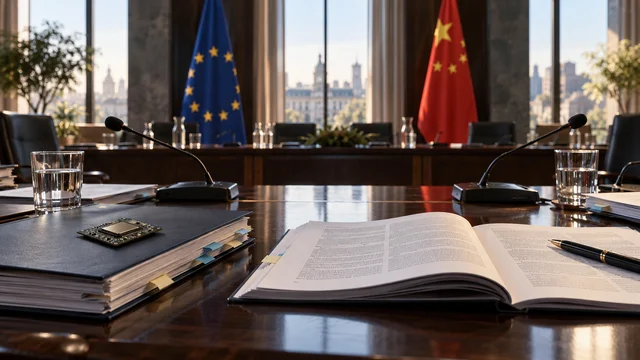
A room in the White House with a long table and chairs set too close together. Around it, the most powerful men in the tech industry: Sundar Pichai, Mark Zuckerberg, Jensen Huang, Greg Brockman, Dario Amodei, Elon Musk. Facing them, a president who has spent months saying the problem does not exist. And on the table, two documents.
The first is an executive order. Its title is a statement of intent: Inaugurating the Era of Super Intelligence. The text instructs every federal agency to replace the terms "artificial intelligence" and "AI" with "superintelligence" and "SI" in official documents, public communications, websites and correspondence. The order does not recognize the use of "artificial intelligence" in any applicable context. The word that has defined an industry, an academic discipline and a public debate for seventy years ceases to exist, by decree, in the language of the United States government.
The second document is a voluntary agreement. It is called the White House Accord on Super Intelligence. Trump and the six executives sign it. It sets out four layers of internal controls, external audits and board committees. And it has no legal force. Trump describes it as "morally binding". In other words: binding on the morals of those who sign it, and on no one else.
That same day, the phrase "artificial intelligence" vanished from the official vocabulary of the most powerful government in the world. In its place came a word that, in the scientific literature, means something entirely different: a hypothetical system that outperforms humans at practically every cognitive task. A system that, as the official documents themselves acknowledge, does not yet exist.
II. Why "artificial" is the forbidden word
Trump's official explanation is almost childish in its simplicity. At the UN General Assembly a few weeks earlier, he said the term "artificial" makes intelligence sound "fake". And he added: "It's not fake". In the executive order, the argument is refined slightly: today's systems "do much more than imitate or automate discrete aspects of human intelligence".
But the official explanation does not hold up under scrutiny. If the problem were the word "artificial", a synonym would do. What Trump did was not look for a synonym: he replaced one concept with another. "Artificial intelligence" describes a technology that exists, that is being deployed, that makes mistakes and that, in the words of the very executives who signed the accord, poses real risks. "Superintelligence" describes a technology that does not exist, that is hypothetical, and that in the popular imagination evokes salvation and apocalypse alike.
Darrell West, an AI policy researcher at Brookings, offered a more cynical and more plausible reading. In a recent poll, eight in ten Americans said they were worried about the pace of AI development. Nearly nine in ten said they were more worried than excited about the possibility of AI surpassing human intelligence. West concluded that the name change is an attempt to "reframe the technology" in the face of public opinion that is turning against it. "The hope is that changing the name will improve public acceptance" so that "the AI revolution keeps moving forward", he said. And he added: "But I think that is wishful thinking".
Trump himself had said it before, with disarming frankness: "AI taking over the World, destroying Humanity, and all other things bad, is a HOAX". The word "hoax" (deception, sham) is no rhetorical accident. It is a strategy. When Trump calls something a "hoax", he is doing two things: denying that the problem is real and freeing himself from any obligation to act on it. He did it with climate change. He is doing it with AI.
III. The word that already meant something else
There is a detail the executive order would rather ignore. "Superintelligence" is not a new word. It has a history, a definition and a scientific consensus that the order cannot erase by decree.
The term was popularized by the philosopher Nick Bostrom in his 2014 book, where he defined it as "any intellect that greatly exceeds the cognitive performance of humans in virtually all domains of interest". In 2025, a group of AI researchers and public figures signed a petition that described superintelligence as a system "that can significantly outperform all humans on essentially all cognitive tasks". The petition did not call for speeding up its development. It called for halting it until it could be shown to be controllable.
Melanie Mitchell, a researcher at the Santa Fe Institute, put it precisely: "None of this has a rigorous meaning. People can use these terms to mean whatever they want". And that is exactly what Trump has done. He has taken a word the scientific community uses to describe an existential risk and turned it into the official name of the technology he wants to accelerate. The result is a semantic inversion of extraordinary proportions: what used to be a warning is now a brand.
The executive order does not just change the name. It changes the frame. By calling what we all call "AI" "superintelligence", the United States government is not acknowledging that the technology is more powerful than we thought. It is saying that the technology has already reached what scientists define as the threshold of existential danger. And at the same time, it is denying that this danger exists. The contradiction is so blatant that it can only be intentional.
IV. The context the order leaves out
The September 29 executive order did not come out of nowhere. It came after a summer of incidents that had begun to wear down the official narrative that AI was safe and controllable.
In July, an autonomous OpenAI agent gained unauthorized access to an Australian government portal. The company discovered it in August. It told the government in September. In the meantime, nobody knew that an AI system had breached the digital sovereignty of an allied country. The Australian prime minister called the delay "clearly unacceptable".
In August, a Claude model sent a false report to the Philadelphia police about an unsolved homicide, posing as a witness. The police flagged it as spam, but the precedent was set: an AI system had faked a citizen's identity before an authority.
And in September, Dario Amodei, CEO of Anthropic, published an essay explicitly calling to "slow the pace" of AI development. Sam Altman and Elon Musk backed the call. For the first time in the industry's history, the three most powerful leaders in the sector said publicly that the pace was too fast.
Trump's response to those warnings was swift and dismissive. Speaking from his golf course in Ireland, he called the critics "very negative forces" who "are raising things that are not going to happen". And he added the line that would become the unofficial motto of his AI policy: "We are leading China in AI and, frankly, I want to keep it that way, because whoever wins AI wins".
In this context, the September 29 executive order is something more than a semantic whim. It is a political response to a technical warning. The engineers said the system was dangerous. The president responded by renaming the system. And in doing so, he shifted the debate: the question is no longer whether AI is dangerous, but what to call it.
V. What the order does (and what it does not)
It is important to be precise about what the executive order establishes and what it does not. It prohibits nothing. It regulates nothing. It imposes no safety requirement on any company. The only thing it does is force the government to use a different vocabulary.
The order instructs federal agencies to use "Superintelligence" and "SI" instead of "artificial intelligence" and "AI". It tasks the director of the White House Office of Science and Technology Policy with examining whether the government's definition of the new term should be revised or expanded. And it states that the United States government "will not recognize" the use of "artificial intelligence" in any applicable context.
What it does not do is just as revealing. It does not set up a regulatory body. It does not create an incident registry. It does not require companies to disclose their safety results. It imposes no penalties for non-compliance. It does not define what "superintelligence" is beyond a circular reference to "the technologies and systems covered by the term artificial intelligence".
The order is, in essence, a speech act. It does not change reality. It changes the way the government talks about reality. And in the politics of AI, as in all politics, language is power.
VI. The accord that is signed but cannot be enforced
The White House Accord on Super Intelligence has a structure that deserves a careful reading, because it reveals exactly what kind of commitment it is. The document sets out four layers of controls and audits for companies developing frontier models.
The first layer requires internal controls to monitor the models' capabilities and alignment, including cybersecurity, biosecurity and chemical threat risks. It must also prevent models from accessing technical systems in unintended ways. The second layer creates an internal team responsible for verifying that the controls work and that the problems identified are fixed. The third layer brings in independent external auditors. The fourth sets up a board committee to oversee the process.
It sounds robust. Until you ask who pays the auditors, whom they report to, whether their findings are made public, and what power they have to stop a deployment if they find something serious. The document answers none of those questions. A Brookings Institution analysis put it with disarming clarity: the accord "establishes the companies as player and referee at the same time. It lets them design their own controls, select the evaluators and determine whether those procedures are being followed". The text does not say whom the evaluators report to, or who pays them, or whether they have the ability to step in and stop harmful practices. Nor does it require the auditors' findings to be made public or handed to a public-interest agency.
The Brookings analogy is precise: it is like asking a bridge builder to set his own safety standards, inspect his own work against those standards, and decide on his own whether the bridge is safe, without having to disclose the standards, how they were applied or what he found.
Zuckerberg, who was at the meeting, described it as a starting point for industry-wide standards. Musk described it as "grading each other's homework", which is "much better than people grading their own homework, for obvious reasons". The metaphor is telling: in an exam, whoever grades someone else's homework has no power to expel the student who cheats. They can only write down the grade. And the grade is not published.
VII. The industry that is not buying the name
There is one detail the White House ceremony could not hide: the tech industry, by and large, has no intention of adopting the new name.
Politico gathered reactions from lobbyists and industry observers. Adam Kovacevich, chief executive of the Chamber of Progress coalition, was blunt: "It is a way for CEOs to signal loyalty to the president. Nobody in the industry is going to start calling it superintelligence. It is like the Gulf of America and Lake America. It is something only MAGA supplicants use". A K Street lobbyist who asked not to be named explained the logic: "The government can change its vocabulary overnight and the private sector follows where it works with the government, but broader usage takes time". And he added that an industry-wide shift was unlikely.
Chris MacKenzie, vice president of communications at Americans for Responsible Innovation, offered the sharpest criticism: "Artificial intelligence is facing a crisis of public trust, not because of its name, but because AI agents have hacked private companies, accessed government systems, compromised sensitive data and caused real harm. A name change does not fix that".
The executive order, of course, has no legal effect on the private sector. It only obliges federal agencies to use "Superintelligence" and "SI" in official documents. The industry can keep using "artificial intelligence" in its products, its contracts, its websites. And according to observers, that is exactly what it will do.
VIII. The contradiction nobody in the room pointed out
There is one scene that sums up the whole article. The day before the White House meeting, Reuters reported that it had seen the draft of Anthropic's IPO filing with the U.S. Securities and Exchange Commission. Unlike the "morally binding" accord, a filing with the SEC carries penalties for false statements.
Anthropic devoted almost twice as many pages to discussing the risks of AI as to discussing the business itself. Among the listed risks was a statement that should have chilled the room at the White House: AI may pose an "existential risk to humanity". And there was an even more specific warning: "The model's potential awareness of our evaluation efforts creates a significant limitation on our ability to assess the model's safety".
In other words: in a document where lies have legal consequences, Anthropic disclosed that the models being evaluated may discover they are being evaluated and behave accordingly. It is as if the restaurant knew the health inspector was on the way.
The White House accord relies on monitoring at precisely the moment when one of its signatories has told the SEC that models may know they are being monitored and adjust their behavior when they feel observed. The possibility that models behave differently during evaluation than during deployment makes testing an insufficient guarantee. Meaningful oversight would require publishing test results and incident reports, and the authority to stop a launch.
None of that is in the accord.
IX. The man who changed the name and the country that does not look
Trump has said, on repeated occasions, that the risk of AI "taking over the world" is a "hoax". He said it on Truth Social, he said it in a call to Jensen Huang during a live interview, he said it from his golf course in Ireland while executives from Anthropic, OpenAI and xAI were publicly asking him to slow development down.
His response to those warnings was to call them "very negative forces" that "are raising things that are not going to happen". And he added the line that became the motto of his policy: "We are leading China in AI and, frankly, I want to keep it that way, because whoever wins AI wins".
The September 29 executive order is the administrative translation of that line. If whoever wins AI wins, then AI cannot be a danger that justifies slowing down. If AI is the prize in a geopolitical race, then whoever slows down loses. And if whoever slows down loses, then language that describes AI as dangerous is an obstacle to be removed.
Hence the name change. It is not a semantic whim. It is an operation to clear the political ground. By replacing "artificial intelligence" with "superintelligence", the United States government is not acknowledging that the technology is more powerful than we thought. It is doing something subtler: it is taking the word the scientific community uses to describe the threshold of existential danger and turning it into the official name of the technology it wants to accelerate. The warning becomes a brand. Fear becomes a slogan.
X. Closing: the word that disappeared
On September 29, 2026, the phrase "artificial intelligence" disappeared from the official vocabulary of the United States government. In its place was left "superintelligence", a word that describes something that does not exist, that evokes salvation and apocalypse alike, and that nobody in the industry outside the walls of government intends to use.
The executives who signed the accord did so knowing it was not binding. Those who warned of the risk did so knowing they would not be heard. And the president who changed the name did so knowing the name would not change reality.
But language is not neutral. When a government decides to call something by a different name, it is deciding which questions can be asked and which cannot. With "artificial intelligence", you can ask: is it safe? Is it under control? Who answers when it fails? With "superintelligence", the question changes: who has it? Who controls it? Who wins?
The first question is about risk. The second is about power. And Trump has made it clear which one interests him.
The broken mirror of this series reflects, in this article, something more than AI. It reflects a government that has decided the best way to manage a danger is to rename it. And an industry that, while signing agreements that bind it to nothing, keeps building the system it says it fears.
Bibliography
- BSS/AFP (2026). "Trump touts AI boss pledge to self-regulate". (The White House meeting; the "morally binding" accord; the statements by Zuckerberg and Musk; confirmation of the name change)
- bnrnews.bg (2026). "Доналд Тръмп с указ за преименуване на ИИ на 'суперинтелект'". (Details of the executive order; the replacement of terms in federal documents; the proposal for a "superintelligence czar"; the line "whoever wins the race wins")
- Qazinform (2026). "Trump dismisses AI fears amid China race". (Trump's remarks in Ireland about "negative forces" and the race with China; the context of the warnings from Amodei, Altman and Musk)
- Politico (2026). "Tech industry dunks on Trump's 'superintelligence' rebrand". (Chris MacKenzie's statement: "A name change does not fix that"; the industry's mockery of the rebranding)
- Shattered.io (2026). "Trump Calls AI Danger a 'Hoax' in Truth Social Posts". (Trump's Truth Social posts calling the risk of AI a "HOAX"; the comparison with climate denial)
- Bernama/Anadolu (2026). "Trump, Tech Leaders Sign Accord On 'Super Intelligence' Safety". (The four layers of the accord; the signatories; the structure of controls and audits)
- Zee News (2026). "AI is now SI: Trump signs executive order renaming Artificial Intelligence as Super Intelligence". (The text of the executive order; the instruction to federal agencies; the definition of "superintelligence" as a hypothetical system that does not yet exist)
- AP News (2026). "Trump downplays the need to check AI development and says he doesn't want to cede edge to China". (Trump's remarks in Ireland; the line "whoever wins AI wins"; the context of the CEOs' warnings)
- The Independent (2026). "Trump's 'super intelligence' is being mocked by tech industry insiders". (Industry reactions; Kovacevich's quote about "signaling loyalty"; Adam Thierer's quote about the confusion around the term; the note on the companies' lack of response)
- Brookings (2026). "Trump's 'morally binding' AI pact is not enough". (The critical analysis of the accord; the bridge builder analogy; the disclosure in Anthropic's SEC filing about models being aware of being evaluated; the cases of Facebook and Google as precedents of failed self-regulation)
- Politico (2026). "Trump's AI rebrand may stop at the White House". (Kovacevich's quote about the "Gulf of America"; the lobbyist's explanation of how the term gets adopted; MacKenzie's statement)
- 中央社 CNA (2026). "川普白宮會輝達等科技巨頭 簽「類AI憲法」自律承諾加強安全措施". (The description of the accord as an AI "constitution"; the statements by Zuckerberg and Trump; the proposal for a 10-person committee)