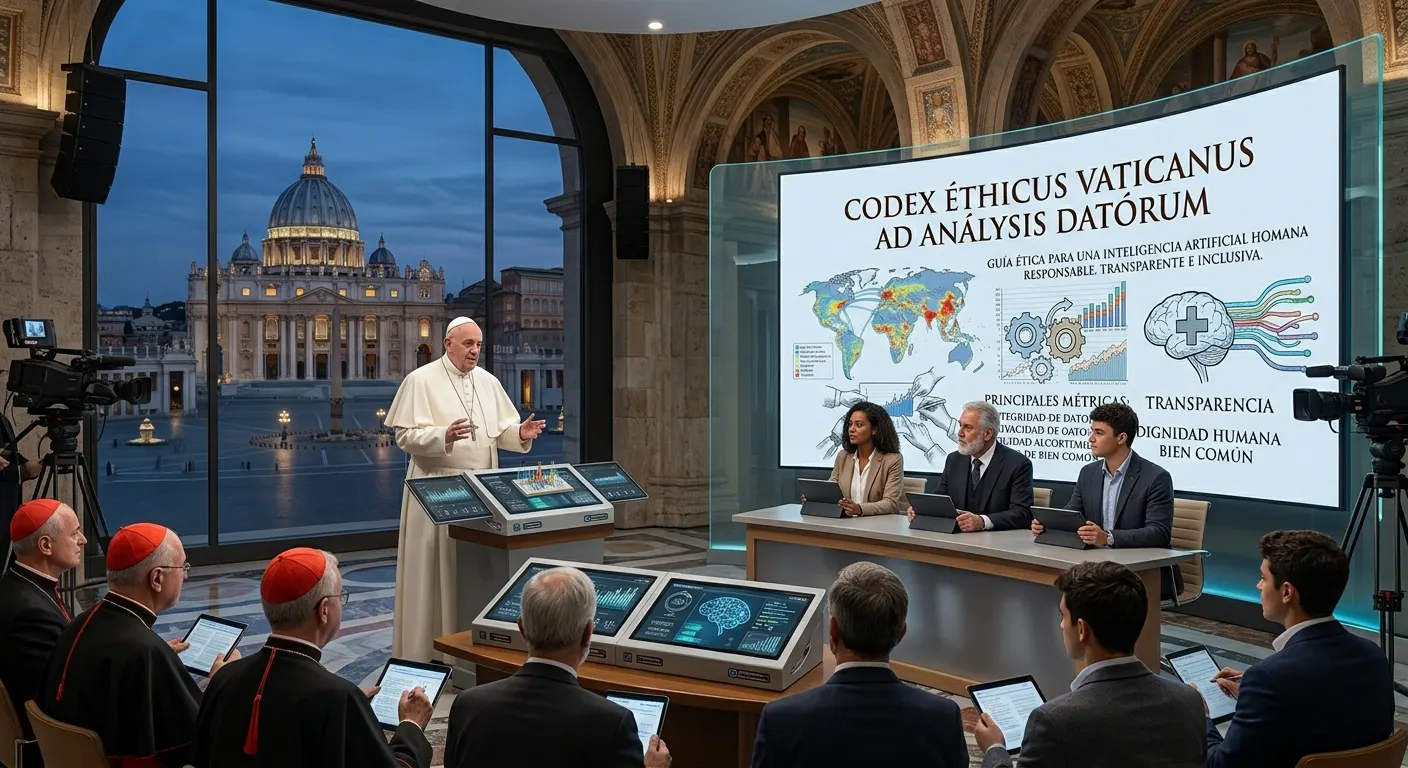
One of the most innovative ideas in Magnifica Humanitas is the extension of the principle of the universal destination of goods—a classic principle of the Church's Social Doctrine holding that the goods of the earth have been given by God to the whole human family to sustain the life of all—to immaterial goods: patents, algorithms, digital platforms, technological infrastructure and, above all, data.
Why data are not the exclusive property of big tech
The Pope maintains that data cannot be considered the exclusive property of the big technology companies. It is the fruit of the collective contribution of millions of people and must therefore be managed as a common or collective good. The encyclical warns that "whoever controls AI will impose their own moral vision, which will become the invisible infrastructure of the systems." Information and data generated collectively cannot benefit only a handful of private actors.
This claim has profound implications. The Pope argues that there should be universal access to technology and training, and that the ownership of data must be regulated, not entrusted exclusively to the private sector. What is needed is "a creativity capable of managing them as one of the common or collective goods, in the logic of sharing," as Saint John Paul II already suggested with regard to collective goods.
The encyclical denounces the fact that "small, highly influential groups can steer information and consumption, condition democratic processes, and influence economic dynamics for their own benefit, contradicting social justice and solidarity among peoples." That is why it is essential that the use of AI—especially when it involves public goods and fundamental rights—be accompanied by clear criteria and effective controls, inspired by participation and subsidiarity.
The principle of the universal destination of goods also applies to the governance of AI. "Today, among the goods that are universally destined for all, we must also include the new forms of property: patents, algorithms, digital platforms, technological infrastructure, data. In a context where the wealth of nations increasingly depends on knowledge and technology, when these goods become concentrated in the hands of a few, without adequate forms of exchange and access, a new imbalance is created that contradicts the universal destination of goods and feeds the gap between the included and the excluded, between those who can take part in the digital revolution and those who remain on the sidelines."
How this contrasts with the EU, China, and the United States
The Vatican's proposal on data contrasts sharply with the approach of other global actors. The European Union, through the AI Act, has adopted an approach centered on protecting fundamental rights and classifying systems according to their level of risk, but it does not treat data ownership as a common good in the sense the Vatican proposes. China has developed a sector-specific regulatory framework that prioritizes national security and state control over information. The United States lacks a comprehensive federal AI law, and its approach is markedly market-driven: it prioritizes private-sector innovation and minimal government intervention. The big technology companies have generally been reluctant to accept any regulation that limits their access to and control over data.
The Vatican thus stands as the only global institutional voice proposing a conception of data as a common good, challenging the private-property model that dominates the technology sector. This proposal has deep roots in the Christian tradition. The Pope recalls that "the Christian tradition never recognized the right to private property as absolute or untouchable," and that its social function should not be regarded as a mere theological opinion but as a certain doctrine of the Church, already present in Sacred Scripture and in the Fathers. "Solidarity, lived in depth, also means 'giving back to the poor what belongs to them.'"
Applying the universal destination of goods to data has practical consequences: transparency in algorithms, independent audits, equitable access to data, and appeal mechanisms for people affected by automated decisions. The Pope insists that the ownership of data cannot be entrusted to the private sector alone but must be regulated.
Digital colonialism: extracting data from entire populations
This vision of data as a common good also has an international dimension. The Vatican denounces "digital colonialism" : the appropriation of health, genetic, and demographic data of entire populations, often under the pretext of aid or research. "Entire territories, especially those with less geopolitical relevance and greater structural fragility, find themselves crossed by a new logic of extraction: that of health flows, epidemiological profiles, genetic maps, and demographic data. These are the new 'rare earths' of power: vital information that, once correlated, can be used to train predictive models, guide investment strategies, anticipate crises and, above all, select who and what matters."
The encyclical concludes: "To turn shared knowledge into a common good, not a tool of domination; to return to peoples not only the data that describe them, but also the possibility of deciding how it will be used, who will use it, and for whom. Otherwise, the digital age will not be postcolonial, but colonial in another form."
This is, perhaps, the Vatican's most radical contribution to the global debate on AI: a critique not only of the abuses of the big technology companies but of the very model of data ownership and control that underpins the digital economy. A critique that, like Leo XIII's Rerum novarum in its day, aims to transform the power structures of a new era.