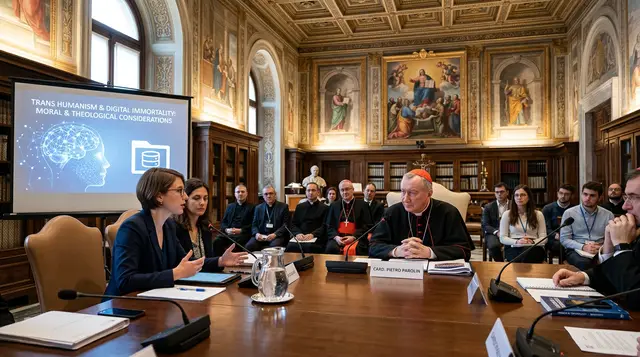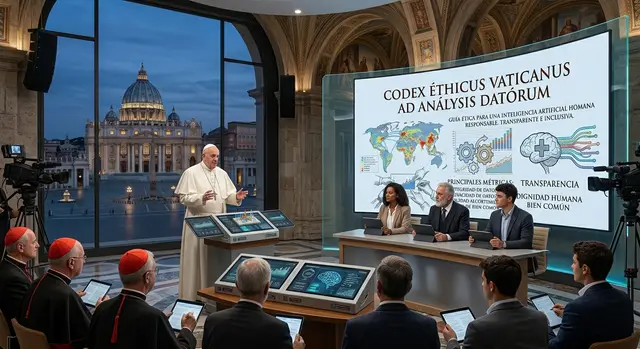
The Holy See has carried out intense diplomatic activity on artificial intelligence during 2026, drawing on its observer status at the United Nations and its bilateral relations with more than 180 states. This activity is no accident: the encyclical Magnifica Humanitas calls for moving from a "culture of power" to a genuine "culture of negotiation," in which dialogue and diplomatic relations become the usual way of dealing with conflict.
Interventions at the UN and in Geneva
On June 19, 2026, the Vatican delegation to the UN in New York took part in an "interactive dialogue" with the co-chairs of the Independent International Scientific Panel on AI, created to produce scientific assessments of the risks and impacts of AI and lay the groundwork for global governance. The delegation stated that "assessing the opportunities and risks connected with artificial intelligence does not mean 'hindering progress' but performing an act of responsibility."
The delegation stressed that "technology is never neutral. It inevitably reflects the priorities and assumptions of those who design, fund, regulate, and use it. Every system embeds choices through what it measures, what it ignores, and what it optimizes." For that reason, "ethical considerations must guide the technical aspects from the outset, rather than being treated as an accessory or an afterthought." The delegation expressed the Holy See's interest in "participating constructively in international efforts aimed at ensuring that artificial intelligence promotes human dignity."
On July 8, 2026, at the AI for Good Global Summit in Geneva—organized by the International Telecommunication Union (ITU) together with other UN agencies and co-sponsored by the Swiss government—the Permanent Mission of the Holy See promoted a high-level conversation devoted to Magnifica Humanitas. The discussion, moderated by Archbishop Ettore Balestrero—Permanent Observer of the Holy See to the UN Office in Geneva—brought together three complementary perspectives: the ethics of AI development (Paolo Carozza, co-chair of Meta's Oversight Board), the business perspective (Artur Kluz, CEO of Kluz Ventures), and the reasons for the Holy See's active participation (Msgr. Paul Tighe, Secretary of the Dicastery for Culture and Education and a member of the Interdicasterial Commission).
The Vatican's presence at the G7
The Vatican's presence at the G7 has also been significant. On May 25, 2026, while the G7 was stalled on international rules for AI and the U.S. Congress was struggling to produce comprehensive federal legislation, the Holy See broke the silence with the encyclical. Catholic bishops backed the Holy See's calls for "ethical governance of artificial intelligence" and "particular vigilance regarding the military uses of autonomous systems." At the Evian summit, G7 leaders took up AI, and the Vatican issued a forceful appeal: "It is not enough to regulate artificial intelligence; it must be disarmed and made welcoming."
The precedent for this presence was set by Pope Francis in June 2024, when he was invited to address world leaders at the G7 summit on the ethics of AI, the first time a Pope had been given that opportunity.
The crisis of multilateralism and a culture of negotiation
The encyclical also addresses the crisis of multilateralism. The institutions created to safeguard a common destiny for peoples—the UN in particular—appear weakened, not only because of structural limitations but because there is no shared will to support and reform them. "The force of international law is thus replaced by the supposed 'law of the strongest,' and its instruments—from the courts competent to try war crimes to the courts called upon to settle disputes between states—are often circumvented or weakened, with devastating consequences for political culture and coexistence."
The Pope calls for an international framework that includes transparency in algorithms and decision-making, independent audits and equitable access to data, appeal mechanisms for people affected by automated decisions, and shared rules to curb the technological arms race.
Vatican diplomacy, however, is not limited to a presence in international forums. The encyclical proposes a change of culture: "In international relations, dialogue is the irreplaceable instrument of diplomacy for preventing conflicts and restoring bonds of trust. In the face of impulsive communications, aggressive rhetoric, and the logic of power that mark our time, the vocation of diplomacy is to foster dialogue with everyone, including those interlocutors considered most 'uncomfortable' or deemed not legitimate to negotiate with, using humility and patience to the utmost to recover the faintest signs of goodwill from the parties in conflict, in order to begin a process of pacification."
Cyberspace, too, has become a field of confrontation: cyberattacks, data manipulation, and influence campaigns orchestrated with the help of AI can destabilize entire countries, even before open armed confrontation is reached. "In this realm, moreover, the attribution of responsibility is often uncertain: when it is unclear who has attacked, the risk grows of disproportionate reactions, errors of judgment, and escalation spirals. That is why we need a diplomacy capable of operating in this new environment as well."
How it compares with the EU, China and the US
A comparison with other global actors reveals differences in approach. The European Union passed the AI Act as the world's first comprehensive regulatory framework, and in April 2026 it signed the Council of Europe Framework Convention on AI, Human Rights, Democracy, and the Rule of Law. China launched an international body with 29 countries in July 2026 to influence global AI rules, with the aim of creating an alternative order. The United States lacks a coherent global governance strategy; the Trump administration has prioritized national competitiveness over international cooperation.
The Vatican, with neither economic nor military power, aspires to play the role of moral mediator and catalyst of consciences in the global debate on AI. Its authority lies in its ability to bring together diverse actors—from tech companies to governments, from religions to international organizations—around shared ethical principles, as shown by the Rome Call for AI Ethics with its more than eleven religions represented and its global technology signatories.