by Research Team from the Laboratory of the Future | Aug 30, 2026 | geopolitics, Theology and Technology
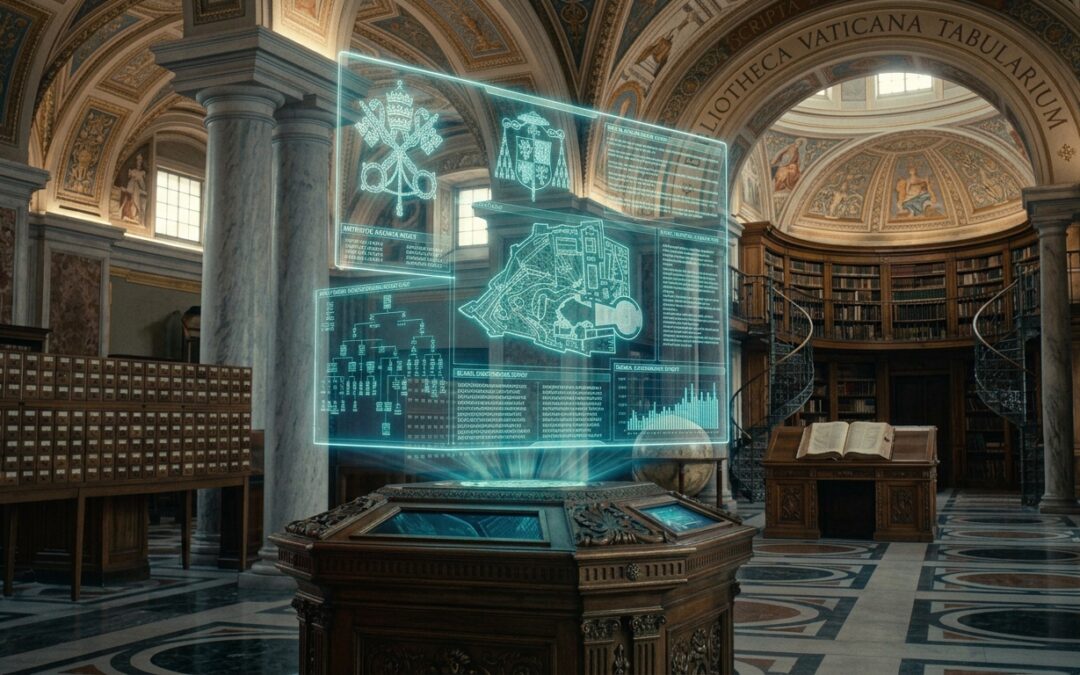
Throughout this journey through the Vatican’s position on artificial intelligence, we have seen how the Holy See has built a complex and articulated response to one of the decisive challenges of our time. From Magnifica Humanitas to the Interdicasterial Commission, from the Rome Call for AI Ethics to diplomatic presence in global forums, the Vatican has combined moral authority with the ability to convene diverse actors around shared ethical principles.
The Vatican’s position differs from other global approaches in several ways. First, it offers an anthropological foundation: the dignity of the person does not depend on utility, efficiency or productivity, but on the person’s condition as a creature loved by God. This foundation allows the Pope to criticize transhumanism, posthumanism and any vision that reduces the person to data or to an optimizable resource.
Second, the Vatican introduces a moral language that goes beyond technical regulation: “disarming AI,” “new digital slaveries,” and “digital colonialism.” The aim is not only to establish norms but to transform mentalities.
Third, the Vatican seeks to act as mediator and catalyst in the global debate. Without military or economic power, its authority rests on its capacity to convene companies, governments, religions and civil society around common ethical commitments. The Rome Call for AI Ethics is the clearest expression of this strategy.
Fourth, the Vatican has developed an institutional architecture that can translate principles into coordinated action: the Interdicasterial Commission, the Observatory for the Environment and the RenAIssance Foundation.
Fifth, it offers a vision of hope. Against technological acceleration, it proposes pause, reflection and dialogue. Against the concentration of power, subsidiarity and participation. Against war, peace and justice. Against domination, service.
The response to Magnifica Humanitas has been diverse. Many experts have valued it as a moral voice that does not bend to incentives. Others have criticized the lack of concrete mechanisms for dismantling existing monopolies or questioned the presence of large technology actors in Vatican conversations. Within the Church itself, some voices are more optimistic and others more cautious.
The future of the Vatican initiative faces several challenges. The first is the speed of technological change, which far exceeds the pace of national and international regulation. The second is the fragmentation of global governance: the European Union moves through the AI Act, China promotes its own international framework, and the United States prioritizes competitiveness. The third is pastoral implementation: principles must be translated into the daily life of communities and Catholic professionals working in technology. The fourth is ecological: the energy, water and mineral footprint of AI demands responses that exceed what the Vatican alone can provide.
Despite these challenges, the Vatican’s position has relevance beyond the religious sphere. In a world where AI is developing at dizzying speed with limited ethical counterweights and fragmented governance, a voice that does not represent economic or geopolitical interests acquires singular importance.
The encyclical concludes with a note of hope, invoking the image of Nehemiah rebuilding the walls of Jerusalem, brick by brick. In the age of digital transformation, the call is not to be resigned spectators or mere commentators of the ruins, but women and men who enter the worksites of history: laboratories, companies, schools, media, institutions and local communities.
At the center stands the faith in the Incarnation: the Word became flesh. Against a world that promises to overcome the human condition through technology, the Vatican recalls that what saves humanity is not a more efficient machine, but a love capable of descending to the most fragile point of history and regenerating it from within.
This may be the Vatican’s most enduring contribution to the debate on AI: the affirmation that, at the center of the digital age, there remains a human face that no machine can ever replace in its splendor.
Annex: Vatican interventions on AI, 2013-2026
- 2013: Pope Francis addresses technology in Evangelii gaudium.
- 2015: Laudato si’ denounces the technocratic paradigm.
- 2020: First signing of the Rome Call for AI Ethics.
- 2024: Pope Francis speaks to the G7 on AI ethics.
- 2025: Publication of Antiqua et nova.
- 2026: Publication of Magnifica Humanitas and creation of the Interdicasterial Commission on AI.
by Research Team from the Laboratory of the Future | Aug 23, 2026 | geopolitics, Theology and Technology
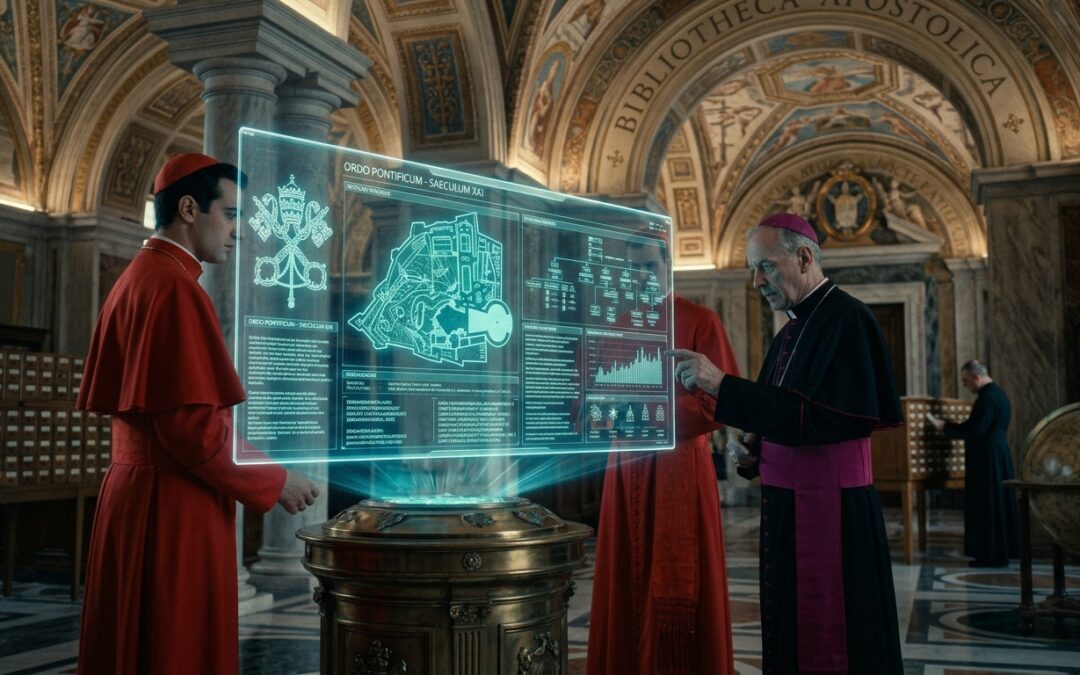
The Holy See has carried out intense diplomatic activity around artificial intelligence in 2026, using its observer status at the United Nations and its bilateral relations with more than 180 states. This activity is not accidental: Magnifica Humanitas calls for a transition from a culture of power to a true culture of negotiation, where dialogue and diplomacy become the usual path for addressing conflict.
On June 19, 2026, the Vatican delegation to the United Nations in New York participated in an interactive dialogue with the co-chairs of the Independent International Scientific Panel on AI. The delegation stated that assessing the opportunities and risks of artificial intelligence does not mean obstructing progress, but exercising responsibility.
The delegation stressed that technology is never neutral. It inevitably reflects the priorities and assumptions of those who design, finance, regulate and use it. Every system incorporates choices through what it measures, what it ignores and what it optimizes. For that reason, ethical considerations must guide technical aspects from the beginning instead of being treated as an accessory or later addition.
On July 8, 2026, during the AI for Good Global Summit in Geneva, the Permanent Mission of the Holy See promoted a high-level conversation dedicated to Magnifica Humanitas. The debate connected the ethics of AI development, business responsibility and the reasons for the Holy See’s active engagement.
The Vatican’s presence in the G7 has also been significant. Pope Francis had already addressed world leaders on AI ethics in 2024. Leo XIV continued and deepened that line, calling not only for regulation but for the disarmament of AI and for technology to become welcoming rather than threatening.
The encyclical also diagnoses the crisis of multilateralism. Institutions created to safeguard the shared destiny of peoples, especially the United Nations, appear weakened not only by structural limits but by the absence of a shared will to support and reform them. The force of international law is often replaced by the supposed right of the strongest.
The Pope calls for an international framework that includes algorithmic transparency, independent audits, equitable access to data, appeal mechanisms for people affected by automated decisions, and shared rules to slow the technological arms race.
Vatican diplomacy is not limited to institutional presence. It proposes a cultural change. In international relations, dialogue is the indispensable instrument of diplomacy, even with interlocutors considered uncomfortable or illegitimate. The goal is to recover even the weakest signs of goodwill and begin a process of pacification.
Cyberspace has also become a field of confrontation. Cyberattacks, data manipulation and influence campaigns assisted by AI can destabilize entire countries even before open armed conflict begins. In this environment, responsibility is often difficult to attribute, increasing the risk of disproportionate responses and escalation. A diplomacy capable of operating in this new environment is therefore essential.
Compared with other global actors, the Vatican occupies a distinct position. The European Union advances through the AI Act; China promotes its own international body; the United States struggles to articulate a coherent global governance strategy. The Vatican, without economic or military power, seeks to act as a moral mediator and a catalyst of conscience.
by Research Team from the Laboratory of the Future | Aug 16, 2026 | geopolitics, Theology and Technology
Magnifica Humanitas devotes an entire chapter to the military use of artificial intelligence. Pope Leo XIV warns that AI can lower the threshold for the use of force and feed a culture in which victims are reduced to data. His appeal is categorical: no algorithm can make war morally acceptable.
The Pope argues that the digital revolution is modifying the grammar of conflict. Visible war is now joined by hybrid forms: cyberattacks, information manipulation, influence campaigns and the automation of strategic decisions. AI accelerates these processes in a context where many technologies are intrinsically ambivalent: what is created to protect can quickly become a tool of attack.
AI does not free conflict from its inhumanity. It can make it faster, more impersonal and more opaque, turning defense into predictive operations and victims into data points. In this way, it accustoms us to the idea that violence is inevitable and must merely be optimized.
The Pope condemns the development of fully autonomous weapons, in which the decision to kill is delegated to automated systems. Moral judgment cannot be reduced to calculation. It implies conscience, personal responsibility and the recognition of the other as a person. For that reason, it is not legitimate to entrust lethal or irreversible decisions to artificial systems.
The encyclical demands traceability and accountability. For every system used in warfare, it must be possible to reconstruct decisions so that responsibility does not dissolve into the machine. Those who plan, train, authorize and deploy such systems must remain identifiable and answerable.
The Pope also denounces the technological arms race, including massive contracts between major technology companies and military institutions. AI may strengthen defense and civilian protection, but it can also lower the threshold for force, obscure responsibility and create a culture in which the enemy becomes a data point and the victim a collateral calculation.
The critique goes beyond autonomous weapons. The encyclical diagnoses the culture of power that normalizes war. Regional conflicts, escalation, cross-threats and territorial ambitions become habitual, while ethical criteria that once limited the use of force erode.
The Pope denounces the connection between economic interests, military systems and political decisions. War becomes a market, and arms industries benefit from conflicts that continue and expand. He also warns against the loss of historical memory, which makes it easier to rewrite the past and forget the lessons of catastrophe.
Against this culture of power, Leo XIV proposes five paths: disarming words, building peace in justice, adopting the gaze of the victims, cultivating a healthy realism and renewing dialogue and multilateralism. Dialogue remains the principal instrument of coexistence among persons and peoples.
Compared with other global actors, the Vatican appears as one of the clearest voices condemning the military use of AI and demanding effective human control. Its alternative is not naivety, but a refusal to accept the idea that technology should make violence easier to exercise and easier to forget.
by Research Team from the Laboratory of the Future | Jul 12, 2026 | geopolitics, Theology and Technology
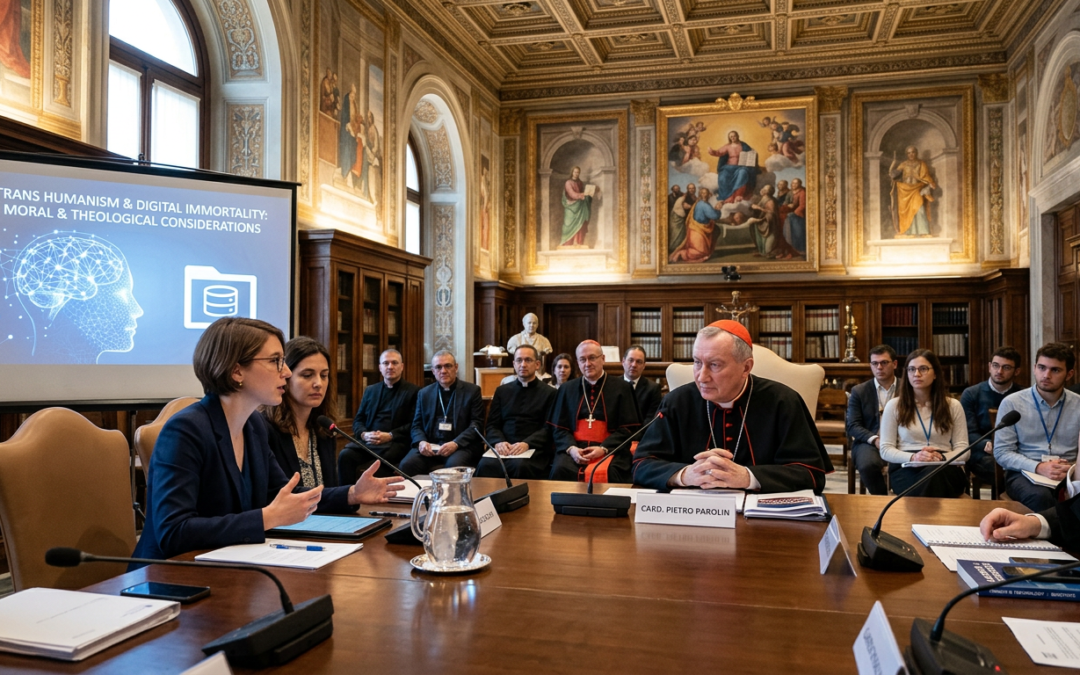
The dream of digital immortality promises a future in which consciousness can be copied, death can be delayed, and the human condition can be redesigned. The Vatican sees in that dream not only ambition, but a profound anthropological risk.
Transhumanism often begins from a legitimate desire: to heal disease, reduce suffering, extend healthy life, and expand human possibility. These goals are not foreign to Christian concern. Medicine, care, and scientific discovery can be expressions of love for the person. The tension begins when healing turns into contempt for limitation itself.
The meaning of the body
Digital immortality frequently assumes that the self is information. If the mind can be mapped, simulated, or uploaded, then perhaps the person can survive beyond the body. The Vatican challenges this assumption. The human person is not merely a pattern of data. Embodiment is not an accidental container; it is part of how people love, suffer, remember, forgive, labor, and belong.
A copy of memories or behaviors may imitate someone, but imitation is not resurrection. A predictive avatar may comfort the living, but it can also blur grief, identity, and consent. The desire to preserve a person can become the production of a convincing artifact.
Finitude and dignity
The Vatican’s critique does not romanticize suffering or death. It does, however, resist the idea that finitude makes human life defective. Mortality gives urgency to responsibility. Vulnerability makes solidarity necessary. Dependence reminds human beings that they are not self-created machines.
A culture obsessed with overcoming limitation can become impatient with the elderly, the disabled, the poor, and anyone whose body does not conform to an ideal of optimization. Transhumanism can therefore become socially dangerous when it divides people into upgraded and obsolete, enhanced and ordinary, efficient and burdensome.
The market for transcendence
The promise of radical enhancement will not arrive equally. It will be shaped by wealth, access, patents, platforms, and geopolitical competition. What is marketed as liberation may become a new hierarchy. The wealthy may buy longevity, cognitive augmentation, or digital legacy while others struggle for basic care.
This is why the Vatican places transhumanism within social ethics, not only metaphysics. The question is not only what technology can do to the human being. It is who controls that technology, who benefits from it, and who is pressured to adapt to it.
A human future
The Vatican’s answer is not to freeze humanity in the past. It is to insist that technological development must remain accountable to a richer understanding of the person. Human beings are not projects to be optimized indefinitely. They are relational, embodied, vulnerable, spiritual, and moral.
The dream of digital immortality may reveal a fear that technology cannot finally solve: the fear of being finite. The challenge is to build technologies that care for life without denying its mystery.

by Research Team from the Laboratory of the Future | Jun 28, 2026 | geopolitics, Globalization, Theology and Technology
The Vatican’s response to artificial intelligence has not been limited to speeches. It has tried to build an institutional architecture capable of sustaining ethical reflection in a technological age.
That architecture matters because AI is not a single invention. It is an ecosystem of laboratories, platforms, public policies, military programs, educational tools, health systems, and everyday applications. A purely reactive ethics would always arrive late. The Vatican’s challenge has been to create spaces where moral reasoning can accompany development rather than merely condemn its consequences.
The need for coordination
Modern technology crosses the boundaries of traditional institutions. AI affects doctrine, diplomacy, education, labor, media, health, migration, family life, and war. No single office can adequately address all of these dimensions. An interdicasterial approach reflects the reality that digital transformation is not a specialized topic. It is a civilizational condition.
By coordinating different areas of expertise, the Vatican can connect theological anthropology with social doctrine, diplomatic engagement, scientific dialogue, and pastoral concern. The point is not bureaucracy for its own sake. It is the recognition that fragmented responses are too weak for systems that operate globally.
The Rome Call
The Rome Call for AI Ethics represents one of the clearest expressions of this strategy. It seeks to gather technology companies, religious communities, universities, and public institutions around shared principles: transparency, inclusion, responsibility, impartiality, reliability, security, and privacy.
The significance of the Rome Call lies not only in its principles, but in its method. It invites actors who do not normally share the same moral vocabulary to enter a common conversation. A corporation may speak of trust and governance; a religious institution may speak of dignity and conscience; a state may speak of public interest and security. The Rome Call tries to create a bridge among these languages.
Ethics before crisis
The history of technology often follows a predictable pattern: invention, adoption, harm, scandal, regulation. The Vatican’s institutional response attempts to interrupt that pattern. It argues that ethical design should not be a repair mechanism after damage has already occurred. It should be part of the architecture from the beginning.
This is especially important because AI systems can create harms that are difficult to see immediately. Bias can be statistical rather than visible. Dependency can be gradual. Surveillance can be normalized through convenience. Human judgment can erode without a dramatic moment of collapse.
A diplomatic role
The Vatican is also a diplomatic actor. It can convene conversations beyond the logic of geopolitical blocs. In a world where AI competition is shaped by rivalry among states and corporations, this convening role is valuable. It does not eliminate conflict, but it can keep alive the idea that technology must be governed by more than strategic advantage.
The Interdicasterial Commission and the Rome Call show that the Vatican understands AI as a long-term institutional question. Moral principles need structures, and structures need persistence. Without them, ethics becomes a declaration; with them, it can become a discipline.