
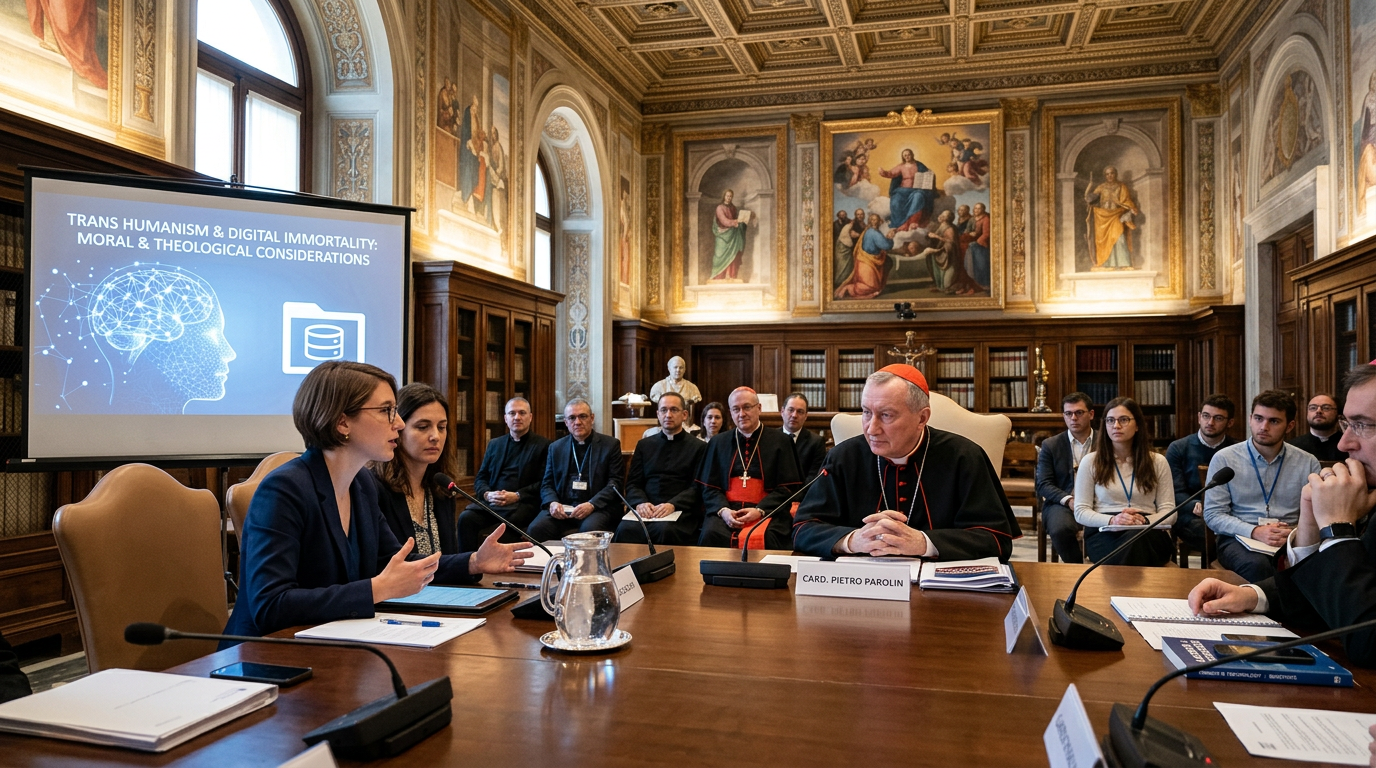

The dream of digital immortality promises a future in which consciousness can be copied, death can be delayed, and the human condition can be redesigned. The Vatican sees in that dream not only ambition, but a profound anthropological risk.
Transhumanism often begins from a legitimate desire: to heal disease, reduce suffering, extend healthy life, and expand human possibility. These goals are not foreign to Christian concern. Medicine, care, and scientific discovery can be expressions of love for the person. The tension begins when healing turns into contempt for limitation itself.
The meaning of the body
Digital immortality frequently assumes that the self is information. If the mind can be mapped, simulated, or uploaded, then perhaps the person can survive beyond the body. The Vatican challenges this assumption. The human person is not merely a pattern of data. Embodiment is not an accidental container; it is part of how people love, suffer, remember, forgive, labor, and belong.
A copy of memories or behaviors may imitate someone, but imitation is not resurrection. A predictive avatar may comfort the living, but it can also blur grief, identity, and consent. The desire to preserve a person can become the production of a convincing artifact.
Finitude and dignity
The Vatican’s critique does not romanticize suffering or death. It does, however, resist the idea that finitude makes human life defective. Mortality gives urgency to responsibility. Vulnerability makes solidarity necessary. Dependence reminds human beings that they are not self-created machines.
A culture obsessed with overcoming limitation can become impatient with the elderly, the disabled, the poor, and anyone whose body does not conform to an ideal of optimization. Transhumanism can therefore become socially dangerous when it divides people into upgraded and obsolete, enhanced and ordinary, efficient and burdensome.
The market for transcendence
The promise of radical enhancement will not arrive equally. It will be shaped by wealth, access, patents, platforms, and geopolitical competition. What is marketed as liberation may become a new hierarchy. The wealthy may buy longevity, cognitive augmentation, or digital legacy while others struggle for basic care.
This is why the Vatican places transhumanism within social ethics, not only metaphysics. The question is not only what technology can do to the human being. It is who controls that technology, who benefits from it, and who is pressured to adapt to it.
A human future
The Vatican’s answer is not to freeze humanity in the past. It is to insist that technological development must remain accountable to a richer understanding of the person. Human beings are not projects to be optimized indefinitely. They are relational, embodied, vulnerable, spiritual, and moral.
The dream of digital immortality may reveal a fear that technology cannot finally solve: the fear of being finite. The challenge is to build technologies that care for life without denying its mystery.
0 Comments