

A narrative chronicle about software that turns artillery flashes into lines of code.
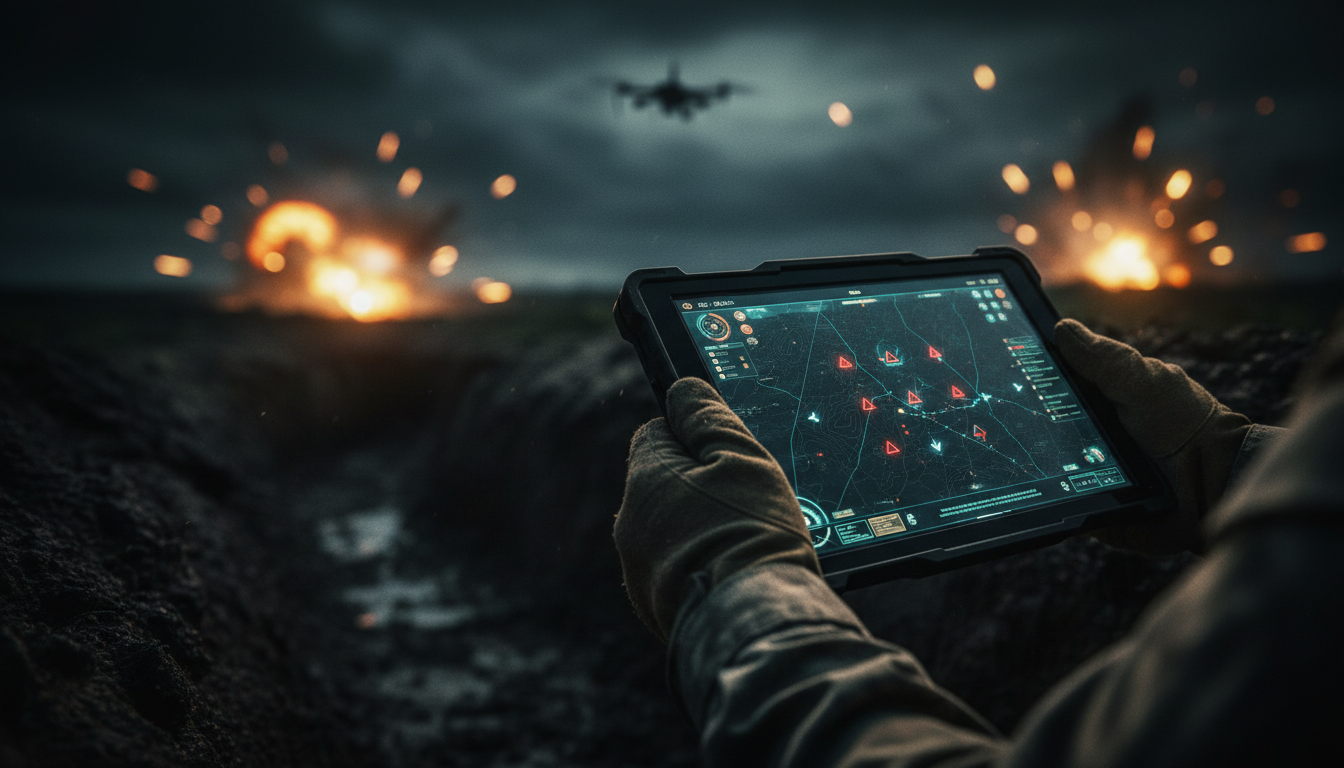
Night has closed over Donetsk oblast. In a makeshift command post, a Ukrainian officer holds a dust-covered tablet while a kamikaze drone hums outside. On the screen, a multicolored mosaic appears: red dots that may be enemy artillery pieces, blue arrows marking civilian evacuation routes, and a blinking counter that reads: Latency = 2.7 s.
Minutes earlier, a commercial satellite captured a burst of images. Seconds later, Gotham correlated them with radio intercepts and Telegram warnings. The officer draws a circle, taps confirm, and, almost without hearing his own order, watches an allied shoot-and-scoot battery fire at the newly marked grid.
This is the eighth chapter of the story: the war of the twenty-first century, where shots still smell of powder, but the decisive movement happens inside GPU clusters hundreds of kilometers away from the front.
The Algorithmic Dawn: Ukraine 2022, the Unscripted Demo
When Russia crossed the border, Kyiv had no time for procurement rituals. Palantir arrived with backpacks and a motto: integrate first, invoice later. In less than ten days, its engineers connected DJI drone feeds, Starlink satellites, AN/TPQ-36 radar, and threads from social networks.
The promise was to fuse everything into a graph that could show, at village scale, who was firing, from where, and with what probability of moving five minutes later. One colonel later remembered that wall of screens: serial number of a tank, estimated GPS position, fuel level. It was like seeing war in Google Maps, but alive.
General-staff manuals became obsolete before they could be printed. The battlefield was no longer only a line of contact; it was a living data structure.
The OODA Loop at Fiber Speed
Strategists once spoke of the OODA loop, Observe, Orient, Decide, Act, as the compass of modern combat. With Gotham, that cycle contracts into three verbs: observe, act, learn. Orientation is automated; decision, often enough, is compressed into a tap on a screen.
A Polish commander involved in training put it bluntly: some platoons fire because the tablet paints the target red; human doubt becomes latency. The danger is obvious. If the enemy injects false data, the graph can transform a mirage into a legitimate target.
To reduce that risk, Palantir added visible confidence scores, color-coded like traffic lights, and a delay button that forces a short pause before fire is launched. But under the roar of drones, the border between reflex and reflection is thin.
Low-Cost Drones and the Sensor Mesh
Ukraine combined Turkish Bayraktars with quadcopters that cost less than a laptop. Each device uploaded telemetry to Foundry; Apollo deployed patches that refined armored-vehicle detection models in hours instead of weeks.
When a cheap drone recorded enemy movement, the video was fragmented, sent through Starlink, reconstructed in a European data center, and pushed to an artillery operator before the drone returned to base. The secret was not only the drone. It was the software that coordinated a swarm of cheap eyes.
The Peaceful Theater: NORD-24 in Norway
In 2024, NATO simulated an Arctic invasion in the NORD-24 exercise. Gotham fused coastal radar, maritime AIS, and temperature sensors in pipelines. When a ghost vessel switched off its transponder, the system reconstructed its path from thermal wakes and cell-phone pings caught by coast-guard antennas.
A Norwegian admiral said it felt like catching a submarine with a net made of data. Critics heard a different alarm: if this level of tracking is justified for defense, how easily can civilian life be patrolled in the same name? Brussels asked for reports; NATO promised proportional use.
War as a Service
Palantir has often preferred value contracts over traditional licenses: payment linked to reduced allied casualties or to the neutralization of enemy systems. In Ukraine, part of the compensation was tied to the precision of HIMARS operations supported by Gotham.
A London think tank warned that monetizing targets creates perverse incentives: war becomes scoreable. Palantir answered that outcome-based pricing aligns cost with lives saved. The debate moved to the United Nations, but consensus did not arrive before the artillery shells did.
Generative AI in the General Staff
With AIP-Defense, officers could ask in ordinary language: what if the enemy cuts the M-03 highway after Izium? The model generated alternative routes, logistics-wear curves, and drafts of operation orders. One captain described it as an invisible staff major.
Yet the model could hallucinate. One day it proposed crossing a bridge that friendly artillery had destroyed weeks earlier. Since then, AIP displays a lag counter: how many minutes have passed since the last satellite verification. Even imagination must carry a timestamp.
Cyber and Kinetic: The Double Helix of Conflict
In February 2025, a Russian wiper virus took down municipal servers in Odesa. Gotham detected the spike in malicious hashes, crossed IP addresses, and linked coordination patterns with ISR drones circling the city.
The correlation suggested an imminent artillery strike. Three blocks were evacuated. The bombardment fell where the disks were already dead. Bits and bullets converged. A U.S. colonel coined the term kill-byte: hard drives are struck to guide projectiles.
From Kabul to Kinshasa
After Afghanistan, several allied commands kept tablets with Gotham preloaded. In 2025, UN Blue Helmets deployed in eastern Congo needed to protect humanitarian convoys. Palantir offered a disarmed version: it did not mark targets, only ambush alerts.
NGOs welcomed fewer attacks; academics feared first-class data regions surrounded by analog darkness. The company insisted that the tool does not kill, it only illuminates. But on the ground, every map is power.
Algorithms and the Law of War
The International Criminal Court began asking whether Gotham captures could be admissible evidence in war-crimes cases. The difficulty lies in inference. If a system labels a vehicle as probable T-90M, is probable enough to convict a commander? Lawyers now answer with their own confidence scores.
Palantir experimented with forensic mode: graphs are frozen, hashes registered, chain of custody preserved. It is a race against volatility, because digital truth ages at the speed of cache.
Epilogue: Phosphorus Flashes, Silicon Glints
Back in Donetsk, the officer watches the smoke dissolve where a rival battery had been alive a minute earlier. He wonders whether wars are won by courage or computation. In Denver, a GPU-usage graph loses a peak; in Kyiv, a mother receives a message from her son: I am fine.
Between those two ends, war becomes an equation close to real time. Palantir sells millimetric certainty in a profession built on chaos. But every reduction in latency evaporates the interval where mercy can still fit. Perhaps the next version needs not only a fire button, but a doubt button.

0 Comments