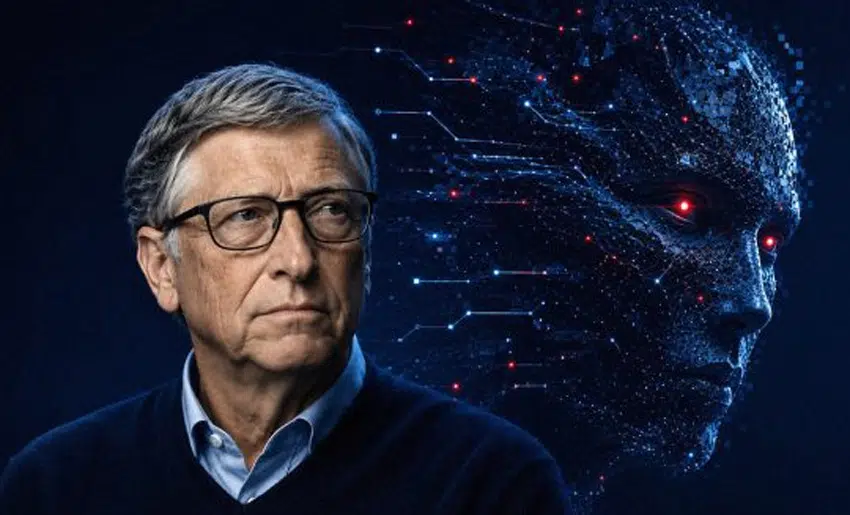

Bill Gates spent fifty years saying “faster.” In August 2026, he said “slower.” This is not a spiritual conversion; it is the forced landing of a technologist who no longer recognizes the machine he helped create. But what if his cry for help arrives too late and is, in rhetorical terms, powerless?
There is an image that has followed Bill Gates since he published his 2026 manifesto. It is not the image of a benevolent philanthropist or of a technological visionary. It is the image of a man who, after decades of preaching speed as the supreme virtue, now asks the world to slow down. Gates himself admits the paradox with striking honesty: “If someone had a credible plan to slow AI advances worldwide, I would probably support it. However, I do not think that is going to happen.”
That sentence is the most sincere confession in the whole text. Gates knows his appeal is largely a rhetorical gesture without material leverage. The geopolitical and economic incentives he knows so well push forward with enormous force. China will not stop its AI race because its growth model depends on it. The United States will not stop because it sees AI as the key to future hegemony. The large technology corporations will not stop because the market punishes hesitation.
What Gates is doing, in reality, is an act of enlightened desperation. He cannot stop the train, but he wants the passengers to know that the bridge ahead may collapse. His manifesto is not a plan of action. It is a war report.
Biography as an interpretive lens
To understand why Gates sees what he sees, one has to trace his biography. The man writing today is not the same person who wrote The Road Ahead in 1995, full of confidence in digital highways. Nor is he exactly the Gates who wrote The Age of AI Has Begun in 2023, still focused on productivity and global health. The Gates of 2026 is a man in his seventies who has watched his father die from Alzheimer’s, devoted billions to fighting disease in Africa, and had enough time to observe how social platforms and digital systems have damaged the social fabric of Western democracies.
His manifesto is shaped by that biography. When he speaks about job loss, he thinks of workers displaced by automation. When he speaks about loneliness and AI companions, he remembers his own youth and the difficulty of learning social skills. When he proposes “Human Reserves,” he thinks of caregivers who understood his father’s needs even when his father could no longer express them.
But that is also the first limit of his analysis. Biography, however rich, is not universal. Gates’s fear is not the fear of an assembly-line worker. It is the fear of a statesman who sees the order that protected him begin to shake.
What Gates sees clearly
Even so, Gates’s diagnosis is, in broad terms, accurate. AI is not like the personal computer or the Internet. Those technologies took decades to penetrate production. AI runs on the devices we already use and speaks in our language. We do not need to learn its logic; it learns ours. That qualitative difference accelerates adoption dramatically.
Gates identifies three major risks: the permanent destruction of jobs, the empowerment of malicious actors, and the amplification of global inequality. On employment, he argues that this is not a cyclical adjustment but a restructuring of capitalism itself, because AI replaces cognition, not only physical labor. On bad actors, he warns that even criminals with limited skills will be able to launch cyberattacks on critical infrastructure. On inequality, he stresses that the free market will concentrate benefits in a handful of corporations and countries.
The power vacuum
The problem is not the diagnosis but the solutions. Gates proposes global governance, “Human Reserves” to preserve certain human tasks, and a tax rebalance between labor and capital. These ideas are interesting, but their feasibility is remote.
Global governance sounds desirable, but code is not fissile material. It is intangible, distributed and reproducible. The climate agenda has been negotiated for decades with insufficient results. AI would demand even more coordination in a context of sharper geopolitical rivalry.
The same happens with taxation. Taxing AI tokens or robots is technically plausible, but politically difficult in a world where large technology companies have extraordinary capacity to avoid and shape tax systems. A global AI tax would face lobbying power in Washington, Brussels and beyond.
The value of the gesture
What remains, then, if Gates’s solutions are politically weak? The gesture remains. The man who benefited most from the digital revolution stands up and says: this is not right. That matters because it breaks the dominant discourse of inevitable progress. Gates tells his peers that speed is not everything and that innovation without a compass can become a race toward the abyss.
But the gesture has a limit. It is the gesture of a man who no longer plays the same game. At seventy, with diversified wealth and a foundation planning to spend enormous sums over the coming years, Gates can afford lucidity because he no longer competes with the same urgency. Had he written this in 2005 or 2015, history might have been different.
The missing political imagination
What is missing from the manifesto is radical political imagination. Gates proposes reforms, not transformations. Why not speak of a drastic reduction in working hours accompanied by a universal basic income? Why not propose a global moratorium on certain AI developments until binding ethical frameworks exist? Why not discuss ownership of AI models and the distribution of their benefits as a social dividend?
Gates does not ask those questions because he remains, deep down, a man of technological capitalism. He believes in private property, markets and philanthropy as levers of change. His imagination is captive to his biography. Yet that is precisely why the manifesto matters: by showing its limits, it forces us to imagine beyond them.
Provisional conclusion
Gates’s manifesto is a war report, not a roadmap. Its value lies in the clarity of the diagnosis and in the moral authority of the person issuing it. Its weakness lies in the timidity of its proposals and in the absence of a realistic account of the powers that would oppose any slowdown. The question it leaves us with is not “how do we implement Gates’s plan?” but “what do we do when the only plan on the table is an open letter no one is obliged to read?”
Bibliography
- Gates, B. (2026). The turbulent AI era is here. The choices we make now are critical. Gates Notes.
- Gates, B. (2023). The Age of AI Has Begun. Gates Notes.
- Gates, B. (1995). The Road Ahead. Viking.
- Brynjolfsson, E. & McAfee, A. (2014). The Second Machine Age. W. W. Norton & Company.
- Zuboff, S. (2019). The Age of Surveillance Capitalism. PublicAffairs.



0 Comments