A few weeks ago, the FDA authorized its limited sale, and a restaurant in Portland added it to its menu. It is produced from fish cells. They say it will not replace farmed or wild salmon, but it could represent a USD 400 million business by 2034.
Collaboration by Claudio Andrade
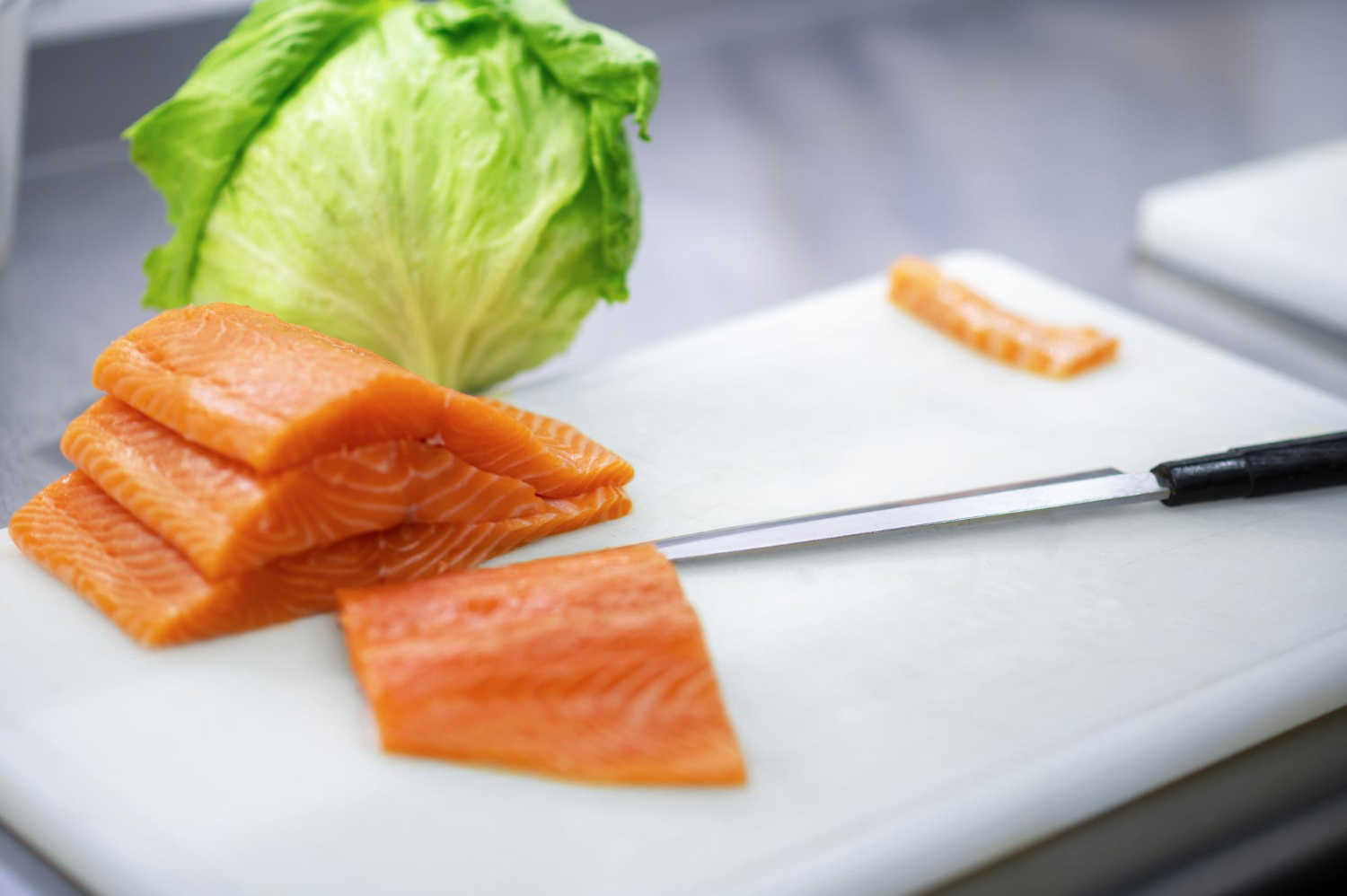
At the end of this past May, the Haitian restaurant “Kann,” located in Portland (Oregon), became the first in the world to offer a dish featuring lab-grown salmon. This happened just days after the United States Food and Drug Administration (FDA) authorized the sale of salmon produced by the company Wildtype in restaurants. It is a first step within the FDA’s health process toward mass commercialization. The product was named Wildtype Salmon Saku by the company. Saku is a cut commonly used in Japanese cuisine.
“As safe as foods produced by other methods,” concluded the agency.
The choice of a restaurant in Portland by the founders of Wildtype is not a coincidence. This city is considered the greenest in the world, where residents have implemented various measures to reduce the community’s impact on the region.
The company has announced that its salmon will soon be served at the Otoko restaurant in Texas.
Nevertheless, the entrepreneurs claim they are not trying to end the aquaculture industry or harm traditional fishermen’s livelihoods. Lab-grown salmon would be just another alternative to address the strong demand for seafood that the planet has faced over the past decade.
It is estimated that by 2050, Earth will reach 10 billion inhabitants, and aquaculture will play a crucial role in food supply. Currently, more than 50% of the seafood we consume comes from aquaculture farms in controlled environments. Global aquaculture production is around 130.9 million tons and continues to grow.
“We are not trying to put fishermen out of work or eliminate the need for fish farming,” said Justin Kolbeck, co-founder of Wildtype, to The Washington Post.
However, all signs indicate that this type of product is here to stay and evolve. Its creators believe an extraordinary business opportunity is beginning to emerge on the horizon.
“We couldn’t think of a better partner to present our cultured salmon than the award-winning chef and author Gregory Gourdet. Weekly service began at the end of May at his James Beard Award-winning Haitian restaurant, Kann, in Portland, Oregon. Diners can now enjoy Wildtype salmon at Kann on Thursday nights in June and, starting in July, every day. Visit Kann’s reservation page to book your spot,” announced Wildtype on their website a few weeks ago.
A Business That Could Reach USD 400 Million by 2034
Currently, the salmon trade moves USD 23 billion annually, and by 2024 it is expected to reach USD 44 billion. Some market analysts emphasize that if lab-grown salmon captures 1% of the market, this niche would represent USD 400 million by 2034.
The dish at the “Kann” restaurant consists of cubes of cultured salmon, accompanied by pickled strawberries, tomatoes, and a rice cracker. The accompanying slogan is: “Be the first in the world to taste the future of sustainable seafood.”
It was not easy to get to this point. The first 453 grams had a “preparation” cost of USD 400 million in 2016. By 2022, the figure dropped to USD 200 for the same volume, and the price could reach USD 7 or 8 in the near future. A figure that would place it below the price of salmon consumed in the United States.
Cultured salmon is not the same as synthetic salmon developed by Revo Foods and New School Foods and presented in 2021. Cultured salmon is produced from cells taken from the salmon at its fry stage. Synthetic salmon is a plant-based product that imitates the texture and flavor of salmon.
How to Create a Salmon Dish in Two Weeks
“As safe as comparable foods produced by other methods,” concluded the U.S. FDA.
For a growing society increasingly obsessed with seafood gastronomy, production time is key. Farmed salmon can take more than two years to reach its ideal weight (about 5 kilos) in the fattening area. Before that, it undergoes the full process including spawning and fertilization, fry rearing, and smoltification. Wild salmon, meanwhile, takes between 3 and 4 years to reach maturity.
In contrast, creating a 220-gram “block” of salmon takes about 2 weeks. This is the typical weight served in restaurant dishes.
Similar to Brewing Beer
The cultured salmon business bases its projection on the market’s own dynamics, particularly the salmon market and aquaculture in general, which has not yet reached its ceiling.
This piece of salmon requires a series of complex steps before becoming edible food. The cells are cultured in stainless steel tanks similar to those used by microbreweries. In this space, they “are fed with a nutrient mix that includes amino acids, vitamins, salts, sugars, proteins, and fats,” details the American media based on the company’s explanation. “Imagine a kind of sophisticated Gatorade,” Kolbeck summarized.
The result of this stage is an amorphous composition that bears no resemblance to farmed or wild salmon as commonly known. It is a substance later mixed with a structure (yes, a sort of plant-based skeleton) made of plant-origin ingredients that help form a “slice” of salmon adding nutrients and orange color.
“I have not seen any exhaustive life cycle analysis comparing this technology with others,” explained Sebastian Belle, president of the National Aquaculture Association. “Ultimately, that’s what we really need to understand: is it better, the same, or worse? And we need to apply that science.”
In recent years, Wildtype attracted the interest and funding of celebrities like Leonardo DiCaprio, Robert Downey Jr., and Jeff Bezos. But the promoters themselves have acknowledged that money for this type of investment is no longer as abundant as two years ago.
In 2021, investment in cultivated meat projects was about USD 1.3 billion. In 2022, it dropped to USD 900 million and by 2024 to less than USD 200 million. In 2018, Wildtype’s founders, Aryé Elfenbein and Kolbeck, raised USD 3.5 million in Venture Capital. They had started two years earlier.
Despite this scenario, the cultured business bases its projection on the inherent dynamics of the market, especially salmon and aquaculture in general, which have not found their ceiling.
In Wildtype’s presentation, a marketing formula emerges that blends science fiction with pure reality.
“‘Saku’ is the Japanese term for a block of raw fish cut evenly, perfect for sashimi. Wild salmon saku is the culmination of nearly a decade of research. The result is a pure, tasty fish cut that respects our seas.
And when they say ‘cut,’ they mean exactly that. A piece of nature that comes out of a laboratory and ends up on a menu in Portland.”



0 Comments