A story told from the cables and the lines of code.
Most data analytics platforms present themselves as multipurpose Swiss Army knives; Gotham, Foundry and Apollo prefer the role of a symphony orchestra.
Each instrument plays its part, but the sound is full only when all three share the same score.
In this chapter of the series we pop the metal lids off the servers and slip in, wrench in hand, among the processes that hold up the giant from Denver. The trip is not for the faint of heart: there are screws still hot, armored network routes and a handful of half-written secrets.
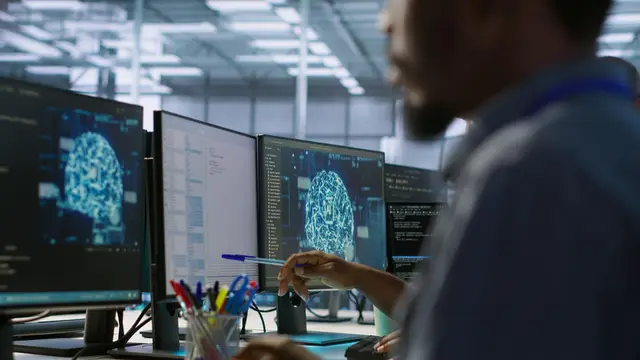
Imagine a windowless room, lit only by the milky glow of several monitors. There, in the half-light, an analyst types in the license plate of some random car: 5-VHX-913. The analyst doesn't know exactly what they are looking for; they sense that this sequence of letters and numbers is the loose end of a thread that could lead to a shipment of drone parts or to a simple human error.
What they do know is that, when they press "Enter," a gigantic, invisible gear train will start turning. That machinery is called Gotham, and it acts like a sleepless detective: it sniffs out records, captures coordinates, cross-references scraps of information that don't even have a name yet, and returns connections that no one would have guessed any other way. It all happens in under a second, without the analyst seeing a single line of code.
Gotham: the detective of the intelligence services
Gotham was born, they say, in a carpeted hallway in Langley, when a CIA agent confessed to feeling unable to piece together the clues arriving from radars, commercial databases and legal wiretaps.
"I have the notes, but not the corkboard or the pins," the agent summed up. That sentence became the seed of software built so that facts (people, places, serial numbers, blurry images) come to life inside an immense, almost organic graph, where everything relates to everything else without losing traceability. Every click is recorded so that, years later, a judge can reconstruct who saw what.
Gotham, in short, doesn't dream: it keeps watch.
Foundry: melting down corporate silos
But the world doesn't end in the corridors of government. Many of the engineers who fed Gotham began receiving emails from companies that had nothing to do with espionage. Airbus, for example, wanted to know whether the same philosophy could reduce maintenance delays; Merck needed to speed up clinical trials; a luxury carmaker was looking to tame terabytes of telemetry.
That is how Foundry came about, named after those old foundries where metal is melted and given new shape. The promise was almost poetic: to melt down corporate silos and let information flow like liquid steel, taking on whatever mold the business needed at any given moment.
To a newcomer, Foundry feels less martial than Gotham. There are no multicolored security passes and no echoes of confiscated phones. You open the laptop and discover, behind the welcome screen, a white canvas where every Excel table, every CSV, every time series of sensor readings takes the shape of a living entity.
The SAP "purchase order" and the Salesforce "order" are recognized as twins separated at birth; a batch of vaccines is linked to the lot of vials that left on an anonymous truck in the rain; the plant manager can sit next to the data scientist and see exactly the same line of lineage that explains why a part fails or a study stalls. When everything is well aligned,
Foundry doesn't need to dazzle with gimmicks: it convinces by showing tangible savings, weeks gained on the calendar and arguments that are finally settled with shared evidence.
Apollo: updating software in isolated environments
Still, there was an obstacle that neither Gotham nor Foundry could get around on their own: the logistics of updates. Software, like a living organism, mutates every day; but many customers operate on isolated networks, sometimes buried underground or sailing beneath the ocean.
How do you send a critical patch to a nuclear submarine without opening a hole in its digital shield? Apollo was born from that question. Think of it as a conductor nobody sees. When a developer hits "commit" in a protected repository, Apollo takes care of compiling, signing, slicing and packaging the new version. If the target environment is in the cloud, the update flies through fiber; if it is in a classified data center, it travels on a hard drive that crosses guarded checkpoints; and if it is below the waterline, it spreads in tiny blocks through very-low-frequency antennas, taking hours but arriving intact. All of this happens while users keep working, unaware of the comings and goings.
Sometimes the poetry of Apollo borders on science fiction. In Britain's Royal Navy they tell of a September night when a security patch traveled halfway around the planet to seal a freshly detected flaw in an encryption module. The submarine Vanguard was continuing its silent patrol; up above, thousands of kilometers away, no one knew for certain where it was. All it took was one coded message, seven letters authorizing the download, and the software healed itself before the vulnerability bulletin was made public. The sailors noticed nothing: the monitors didn't even flicker. That is, according to Palantir, the measure of Apollo's success: the absence of alarms.
When large language models burst onto the scene, Palantir was quick to present them as a new guest at the party. They could call the creature "AIP," "generative AI" or whatever they liked, but the essence was the same: let an analyst ask a question in English and have the platform answer in SQL, in Python or in understandable charts, all without violating a single confidentiality label. The leap seems modest until you see it in action: logistics routes that took hours are optimized in seconds; hyperlinks between legal documents emerge like fireflies in a dark forest; reports that once languished in bureaucratic queues are generated on the fly, ready for a regulator's approval.
Vendor dependence and "sovereign infrastructure"
All these benefits, of course, come with doubts that are not mere academic rhetoric. To what extent is a customer trapped in an ecosystem whose ontologies only the vendor itself understands? What happens when an algorithm designed to prioritize ambulances ends up, with a different set of data, tracking protesters? How much transparency is possible without exposing state secrets? Alex Karp usually answers that technological neutrality does not exist and that, therefore, ethics lies in choosing carefully which hands operate the tool. His critics reply that entrusting so much power to corporate promises amounts to asking the wolf to guard the henhouse. The debate, far from running out of steam, is growing at the same pace as the platform's adoption.
Meanwhile, daily life inside Gotham, Foundry and Apollo carries on like a wide river. On any given afternoon, a data engineer drags a dusty file onto the canvas; the ontology embraces it, cleans it, links it. Across the Atlantic, an intelligence officer draws a triangle on the map and watches air routes, anomalous transactions and shipments of metal parts light up. Neither of them thinks about the magic that holds it all together. And perhaps that is the real feat: hiding the complexity so that human attention can focus on the decision, not on the tool.
Today, with one foot firmly in public contracts and the other digging ever deeper into private operations, Palantir sees itself as a provider of "sovereign data infrastructure." Its detractors would prefer to call it a gatekeeper. Whichever term prevails, the Gotham-Foundry-Apollo trio has shown that it can move from the war room to the car dealership without changing a single screw, and that the same scaffolding that protects state secrets can be used to improve the punctuality of a commuter train. What remains to be seen is whether that range of uses will ultimately be its main competitive advantage or the seed of regulatory scrutiny that ends up forcing breakups, limits and firewalls.
For now, the screens keep glowing in windowless rooms. The analyst stops the search, saves the case and logs out. On the other side of the wall, the servers breathe quietly, aware that tomorrow will bring new license plates, new batches of vaccines, new nameless data ready to be woven into the same network. That is how Palantir's hidden heart works: beating without clamor, convinced that the narrative does not depend on the shape of the cables or the color of the diagrams, but on the story that the data are, finally, able to tell.