A narrative chronicle on the conquest of the private sector
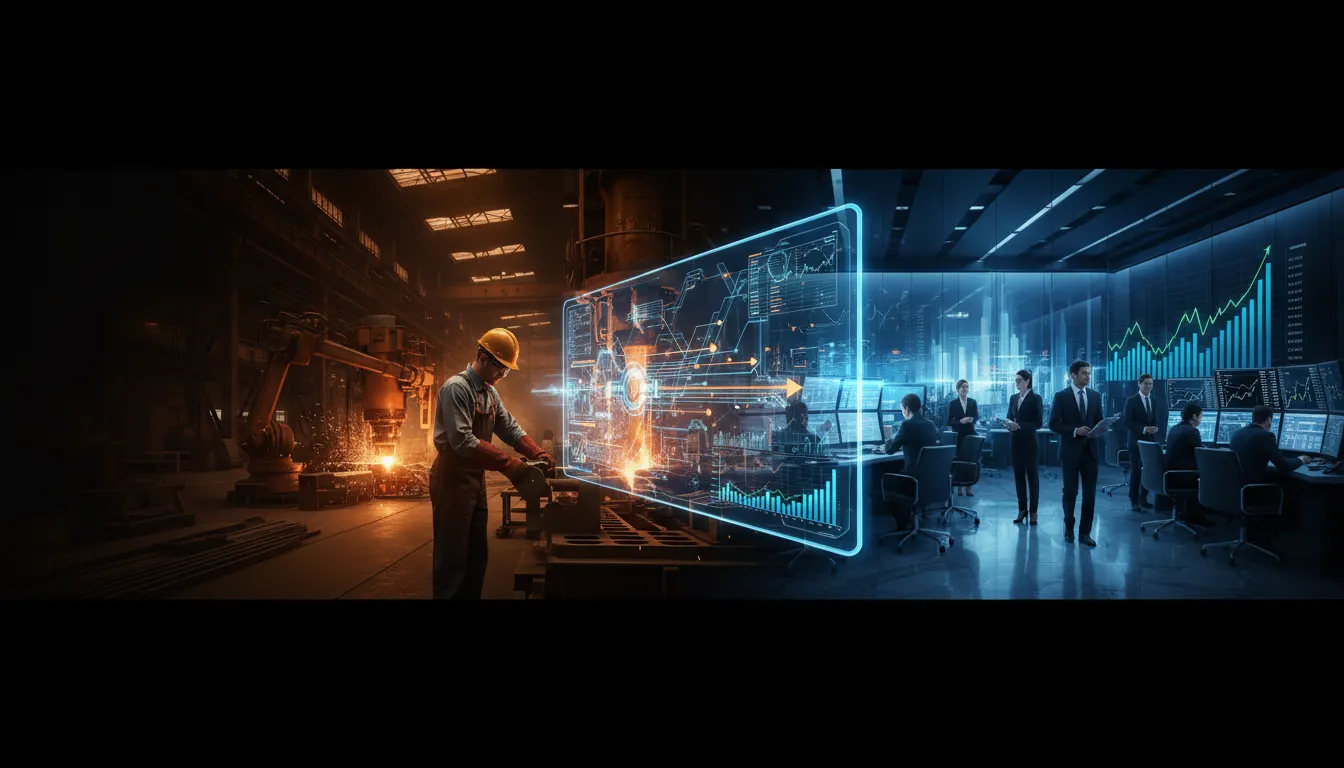
A process engineer at a steel mill in Duisburg marks the end of his shift with rust-stained hands.
Before hanging up his helmet, he casts one last look at the screen hanging above the continuous casting line: the scrap rate–the proportion of steel that ends up in the scrapyard–has fallen from 12% to 4% in six months.
No one asked him to memorize that number, but he does; because he knows that behind the drop beats a piece of software that has never set foot in the steelworks, a system the operators already call, with a wink, "the oracle." Its official name is Foundry, and it is signed by Palantir Technologies.
This is how the journey begins of a tool forged in government clandestinity that ends up, without asking permission, embedded in the guts of supply chains, corporate crisis rooms, and carpeted corridors where the word "risk" is written with the same gravity as "profit."
Airbus and the steel mill: the first industrial cases
The civilian baptism: Airbus and the theory of lost minutes:
201H. Hangar 14 in Toulouse-Blagnac. A freshly painted A350 waits for the technicians to sign off on its release for flight. What is holding up departure is not a mechanical failure but the absence of two special nuts whose SKU exists only in a lost Excel sheet. A weary engineer—a retired ex-F-18 man—suggests "trying that thing the CIA uses." The following month, a thin Palantir team lands in France with carry-on backpacks and the cautious phrasing of someone who still fears the questions raised at the European Union's table.
The logic of the trial was simple: connect inventory, logistics, and aircraft telemetry in a single dashboard. The magic arrived in the crucial metric: every minute an aircraft does not fly costs 50 euros in fixed expenses and 90 euros in lost opportunity. Six months later, Airbus renames the project Skywise and signs an unheard-of clause: Palantir will get paid only if it reduces delays. It worked. The plant's second hangar copied the dashboard; then the helicopter division; later, the airline customers. No one remembers the original nuts anymore, but everyone recalls the first time they saw the backlog evaporate before their eyes.
The song of the mill: steelmaking, sensors, and the smell of gas.
The Duisburg steelworks was not the only case. In Ohio, an auto plant integrated a thousand legacy PLCs with a forty-year history of defective parts. They found ghostly correlations: a humidity spike in secondary warehouse aisles anticipated defects in door polishing. The quality manager became famous for walking around with a hygrometer, like a dowser of the digital age.
Foundry, with its Frankenstein-style ontology–pieces of SAP stitched together with CSV files and blurry photos of barcodes–did not distinguish between "serious data" and "anecdote." It simply lined them up in a temporal river and let the anomalies leap from the water like restless fish. The moral kept repeating: better an imperfect insight today than a beautiful dashboard once production has already stopped.
Wall Street and the boardroom
Wall Street raises an eyebrow: variable contracts, uncertain margins:
When Palantir went public in 2020, analysts rubbed their eyes at a billing model that seemed written by playwrights, not accountants. There were no perpetual licenses or seat packages; the company preferred "as-you-save" contracts, percentages of the value generated, and equity in start-ups if need be. The audit committee of a consumer goods multinational refused to sign: "We can't pay for something whose invoice we don't know how to calculate."
Two years later, the same company came back with its head bowed: its direct rival had cut its inventory cycle by 18% using Foundry and was showing off the figure in every earnings presentation. The CFO who had once hesitated now asked, almost in secret, whether it was still possible to get into the "algorithm club."
The elevator to the top: the Chief Data Officer joins the board.
Boards of directors, reluctant to deal with the jargon of graphs and ETLs, adopted a rhetorical shortcut: "Palantir is the command console." With that phrase, the role of the Chief Data Officer stopped being anecdotal and rose to the big table.
At a Swiss pharmaceutical company, the CDO won a veto over mergers if the data silos could not be integrated in less than a quarter. Where liabilities and cash flow were once measured, a page now appeared titled "Cost of ontological alignment." An investment fund, sniffing out the trend, launched a stock index of "companies with native data architecture" and sold it as insurance against supply chain disruptions.
Apollo and artificial intelligence in daily operations
Apollo in hostile territory: factories, ships, and hybrid clouds.
The biggest surprise in the private sector was not Foundry but Apollo. If updating a nuclear submarine already sounded like a feat, patching an AI cluster on an oil tanker sailing the Java Sea borders on science fiction. Palantir convinced the shipping company that OTA (over-the-air) updates were safer than waiting for port. The promise: automatic rollback if RAM consumption rose by 2%. It worked.
That day, CIOs across half the planet understood that Apollo was, in reality, insurance against the bureaucracy of change: fewer CABs, fewer maintenance windows, fewer scares during peak production hours. Paying for "peace of mind without latency" became acceptable, almost elegant.
AI knocks at the door: chat over Excel, Python that writes itself:
2023 Operations office in Chicago. A financial analyst types: "Where does the cost of capital spike if crude rises to $105?" The system answers not with a report but with a Python script ready to run. The analyst blinks, hits Enter. Within five seconds, a chart compares scenarios. The Artificial Intelligence Platform (AIP) has been born, the friendly–or perhaps too effective–face of generative AI in the corporate environment.
The trick lies not in the LLM but in the restrictions: every answer comes wrapped in row-level permissions, just as in Gotham. The in-house lawyer can review which query touched which column before the chart sees the light of day. It is an unusual pact: linguistic creativity, yes; a data free-for-all, no.
Contracts, dependence and European regulation
The fine print: clauses, lock-in, and the "divorce rate".
As adoption grew, so did the fine print. A typical Foundry contract includes a right of first refusal on future savings, "embedded" engineering access and, on occasion, equity if the client creates spin-offs based on the platform. Start-ups appreciate the muscle; the giants see the shadow of lock-in.
An audit firm coined the term "Palantir divorce rate": the years and millions needed to migrate to an alternative. Today's average is five years and $40 million. It is not an absolute padlock, but it is a reminder that once ontologies tie down the tables, every row of business ends up tattooed with proprietary metadata.
Brussels appears again: DORA, NIS2, and the digital resilience exam.
European financial regulation–DORA–demands cyber resilience testing. Banks that run Gotham or Foundry must show that a vendor failure will not leave them in the dark. Palantir responds with "island mode": a script that seals the system, decouples live telemetry, and allows operation for days without calls to the cloud. It worked in drills; it remains to be seen in a real cyberattack.
Regulators, half skeptical and half fascinated, ask for black-box audits: they do not need the code, but they do need a guarantee that an algorithm will not sink a stock market. Attention shifts from "what it does" to "what it could break if it fails." Hundreds of millions in fines and the platform's prestige are at stake in that nuance.
Sustainability and criticism of an opaque software
Crossed narratives: from steel to the ESG algorithm.
Palantir, aware of the environmental tide, repackages its dashboards as an ESG compass. What used to be scrap rate is now sold as "carbon footprint reduction"; what used to be inventory ownership is translated into "supply chain ethics." A textile company in Southeast Asia boasted to a European client: "Our cotton is tracked inch by inch; Gotham certifies it." The marketing did its part, but the real value lay in avoiding a container held up on suspicion of forced labor.
At the same time, detractors warn of a capitalist Frankenstein: an engine created to hunt terrorists now optimizes dividends and builds sustainability narratives without showing its innards.
Is it legitimate to entrust one's climate reputation to software as opaque as it is powerful? The question haunts shareholder meetings, with no definitive answer.
Epilogue: silicon heartbeats and the smell of office coffee.
It is 3:17 a.m. at the logistics hub of a global retailer. An operator yawns, sips lukewarm coffee, and looks at the heat maps: the algorithm is reorganizing delivery routes to dodge an unexpected storm in Kansas.
More than 2,000 trucks will change their route sheets while the country sleeps. No one will call that operator a hero of e-commerce, but if the storm passes without delays, the quarterly balance sheet will show a one-decimal margin that will decide bonuses at the board meeting.
Thus, far from the spotlights of Langley and the roar of the stock exchange, Palantir writes its private chapter: silent, pragmatic, sticky as machine oil. Every certified saving becomes a testimonial; every basis point of margin, a sales pitch. And while the numbers grow, the old questions return in new disguise: who audits the oracle? Who decides whether a lost minute is worth the price of exposing the entire value chain to an eye that never blinks?
For now, the answers remain pending. In the hangars, in the steelworks, in the banks' crisis rooms, the oracle keeps speaking; and steel, nuts, and spreadsheets seem, for the first time, to dance to the same beat.